African autocrats — and the US right wing — demand “sovereignty” at a Family Values conference in Accra
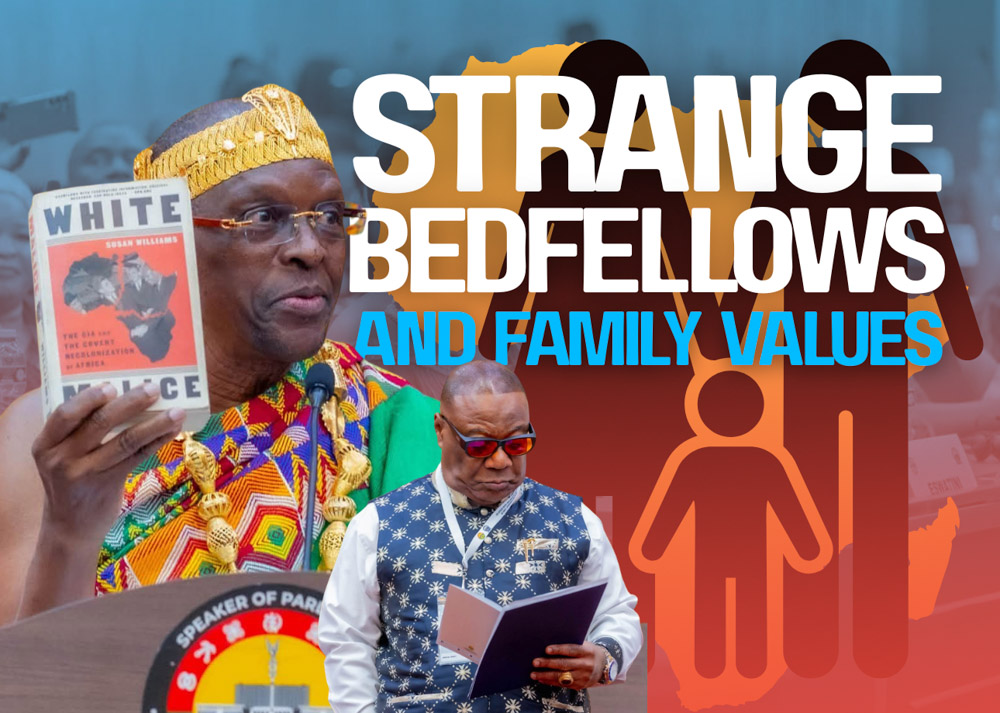
“I recommend that all of you read this book,” the Speaker of Ghana’s Parliament and keynote speaker, Alban Bagbin, says as he — resplendent in traditional kente dress with a matching crown — addresses the 4th African Family Values Conference in Accra. Representatives of twenty African legislatures peer at the book he defiantly holds up: White Malice. It deals with white Western — especially CIA-plotted — counterrevolutionary operations in postcolonial Africa.
UK-based historian Susan Williams, who wrote the book, might be surprised to learn that it is featured so prominently here, at a conference that, in a series welded together with white Western Christian nationalists, seeks to put women back under the authority of husbands and fathers, LGBTQIA+ people in jail, and ‘confused youth’ back in the village to be disciplined by local chief and church.
Welcome to the 4th African Inter-Parliamentary Family Values Conference in Accra, Ghana, held at the country’s Parliament House, which has been cordoned off for the occasion by military and police. The event is being celebrated as the first to take place outside Uganda, whose autocratic leader, 81-year-old Yoweri Museveni, is now the guest of honour.
Blackwash
It is also the first in which one has to look hard to find representatives of the US Christian right. These actors have been much more prominently present at the start of this continuing series, particularly at the inaugural conference held in Utah, USA, in 2022 under the auspices of the Trump administration–aligned Family Watch International (FWI) and its head, Sharon Slater. White participants were also still highly visible at the two previous conferences held in Uganda, where Slater and FWI’s partner, Christian Council International, appeared in numerous photographs with Ugandan President Yoweri Museveni and his wife, and where Slater also spoke.
But while the logo of this fourth conference still incorporates the first, unveiled in Utah in 2022 — an outline of the African continent with a nuclear family inside — the white presence has, in effect, been sort of blackwashed. Slater and her entourage are absent, and the message articulated by many here, now, is unequivocal: we are all Africans here. “Our own governments have paid for all this,” emphasises the Ugandan delegate. The same message of ownership is echoed throughout: this is all ours, independent Africans. Nobody tells us what to do — not white people, not “gays”, not modern feminist ideologies, not the “West” with its “colonial” demands and the conditions it attaches to aid and trade, and not NGOs.
Russia is an enthusiastic supporter
If the Ugandan delegate is telling the truth, this would exclude even Russia, which reportedly funded the first conference in her country in 2023 and has also, in other ways, enthusiastically supported the anti-Western orientation of the African Family Values movement. (This likely also explains the presence here of Russia’s friendly, military-junta-ruled Burkina Faso, which, like Uganda and Ghana, has recently passed a severe anti-LGBTQI bill, and the prospect of Burkina Faso hosting the next conference in 2027.)
But while this entire conference series has been marked by odd bedfellows — from African patriarchs such as Museveni, to Trump-aligned Christian nationalists, to Russian meddlers, and even some Dutch Bible-thumpers, about whom more later — in the past, the main colour here this week, as noted, is black.
Founding fathers
“We are sovereign,” they keep repeating, with many references to the All-African People’s Conferences, also held here in Accra at the end of the colonial period in the last century. Those conferences were organised and addressed by founding figures such as Kwame Nkrumah and Julius Nyerere. Those gathered here — delegations from 20 out of 55 African countries — appear to mean this quite literally as they advocate a return to hierarchical and patriarchal structures in their societies, calling for systems in which chiefs rule over subjects, fathers over families, churches over communities, youth are disciplined and kept away from “poisonous” ideas, and leaders are left to govern as they see fit. All present seem to agree that such systems are “traditionally African” and should be defended mainly against Western influences.
Progressive ideologies “pollute the minds and hearts of African children”
“We find ourselves as gatekeepers of our nations at a time when the world is highly influenced by progressive woke ideology, driven by nefarious entities anchored in secular humanism. These dangerous progressive ideologies are influencing global politics and polluting the minds and hearts of African children and youth,” says Eswatini delegate and opening speaker Lindiwe Dlamini, who is also the Speaker of the Senate in her country. She names “attacks on the African family,” which “manifest as rising divorce rates, child neglect, the erosion of parental authority, and cultural confusion among our youth,” and defines “our role as parliamentarians” as being to “protect the right of African societies to define ‘family’ in a way that reflects our history, our faith and our lived realities. That is sovereignty.”
Natural wealth
The word “sovereign” will still be heard many times during this conference, but not only in the context of what happens to African children. It is mentioned, often strikingly, when addressing governance over the natural wealth contained in the soil of many of the countries represented, and especially the “conditions” attached to Western development aid and trade agreements. The parliamentary delegations here appear to feel strongly about not having anybody poking their noses into their business.
"Sovereignty” is claimed by some of the most oppressive countries
Minerals are among the first things mentioned by Eswatini’s Speaker, Dlamini, who even cites specific figures: “(We hold) over 30% of the world’s known mineral reserves, along with large deposits of oil and gas, and 60% of the world’s uncultivated arable land. (…) The continent is (also) critical to global modern technology, holding 50% of the world’s cobalt, used for batteries, and 40% of its gold. We also have the largest reserves of diamonds and uranium. Yet Africa remains economically disadvantaged due to exploitative contracts, foreign control, and a lack of value addition. We live in a global community, and international cooperation is critical. However, this must not be at the expense of our sovereignty.”
In the case of Eswatini, the sovereignty of its leader, King Mswati III — also notorious for alleged misuse of public funds has been well established after his regime banned political parties and, in 2023, killed dozens of pro-democracy protesters. (Mswati is also known for having 11 wives, not exactly the nuclear family favoured by the gathering here, but his representative Lindiwe Dlamini has explained that “we work in unity across our nations, enriched by our diverse cultural identities.”)
“Godfather” Uganda
Fellow conference founding member and upcoming 2027 conference host Burkina Faso also doesn’t seem to have much to complain about in terms of sovereignty, at least not since its military rulers kicked out former French colonisers and instead gave Russia access to the country’s gold and uranium mines. The same applies to Cameroon, where powerful politicians, with relatively limited interference, facilitate the shipment of timber out of the country’s ports on a large scale. Conference “godfather” Uganda, which has recently passed a law prohibiting local democratic organisations from receiving foreign funding while keeping opposition leaders in jail or exile, also appears already well-versed in the defence of its sovereignty. The only government dealing with Western “conditions” in this context is Zambia, though it appears to do so wholeheartedly, steadfastly favouring “foreign” access to its many mineral resources over community-based artisanal mining.
“The media have been used to reculture our Africans”
Though most countries represented here have governments widely known for suppressing dissent (in addition to those already mentioned, of the twenty conference participants, Morocco, Burundi, Tanzania, Kenya, Zimbabwe, the DRC, Chad, Madagascar, and Mozambique also have poor human rights records), more action is still needed to strengthen their leaders’ “sovereignty,” says Nigerian delegate Segun Adebayo. “If we ignore the power of civil society organisations, this (conference) may remain a talkshop. We must also consider the media (because they) have been used to reculture our Africans.”
Antivax
Perhaps notably, amid the prevailing pan-African messaging, there are still three white men present (did they not receive the memo?) The most recognisable is Henk Jan Schothorst, who, through his Bodegraven, Netherlands-based Christian Council International (CCI), has, together with US counterpart Sharon Slater, been one of the early initiators of the Family Values Conferences drive across Africa. Alongside Schothorst is fellow CCI delegate Wilmer Hak, the organisation’s policy officer and co-author — together with Van Schothorst — of a recent article questioning vaccines. Hak has also highlighted CCI’s anti-abortion and pro-traditional marriage campaigns in a 2024 newsletter. The third white man, wearing a black shirt and white clerical collar, can only be a Dutch dominee.
The Christian right’s embrace is again evident when the health care session at this conference also turns anti-vaccine, resulting in the adoption of a resolution opposing vaccines as part of the ‘African Family Values Charter’ being adopted here. Both the Christian Council and its partner, Family Watch International, have close ties with the equally anti-vax RFK-led US health department under Donald Trump.
The archbishop channels Martin Luther King
Also, interestingly, is host, speaker and organiser, archbishop Nicholas Duncan-Williams, who, though Ghanaian, leads an evangelical church with branches in Maryland and Baltimore. The archbishop is also an attendee of Trump breakfasts and a friend of Trump’s faith adviser Paula White, as well as the husband of a former U.S. trade representative who now does PR work in the United States for both the Ghanaian and Ugandan governments. (“He dumped his wife of 30 years for her,” says a colleague from the Ghanaian press. “So much for family values.”)
Duncan-Williams has charisma, though. He delivers his host address in the manner of the evangelist he is, loudly, with sweeping gestures, and a thick American accent. He even channels Martin Luther King Jr., bellowing “I have a dream,” before invoking images of a prosperous Africa.
Return on investment
The US Christian nationalist, Trump-aligned investment in the series of “African Family Values” conferences held since 2022 has been so large that the question of what they expect their return on investment to be seems valid — especially now that their “baby,” once started in Utah, flies increasingly independently and “decolonial” across the continent.
Maybe a beginning of the answer lies in the trip to the DRC last year undertaken by host speaker and organiser, archbishop Nicholas Duncan-Williams—he of the Martin Luther King speech and the US trade representative’s wife. Together with the Trump administration, faith leader Paula White, he met with DRC president Félix Tshisekedi to discuss an impending US-brokered regional peace treaty, aimed at ending conflict in exchange for “regional economic cooperation.” Among the companies benefiting from this cooperation, focused on securing US access to critical minerals, has been KoBold Metals, backed by billionaires close to Donald Trump.
No pickets
Outside, Ghana’s small LGBTQI community and progressive NGOs, who had initially planned to picket in protest, are nowhere to be seen. This is possibly due to the police and army presence, since — after Uganda and Burkina Faso — Ghana has also recently passed an anti-LGBTQIA+ law that puts those “practising homosexuality” at risk of arrest and imprisonment. The fact that three different venues were announced, keeping Parliament House secret from the public for as long as possible, may also have played a role.
The protestors now mainly fulminate on social media, repeating that there is very little “African” about the “family values” being defended here. Since when are African families nuclear? Have different sexual orientations not always been part of any culture, including in Africa? Haven’t African and Black women generally fought and sacrificed for equality and for reproductive rights?
Only the South African delegate asks about the women
But we are really not talking much about gays, or even women, here. Save for one or two foam-at-the-mouth gay haters who shout about outlawing “perversions” and excluding sexual rights from human rights documents, the conference stays more focused on the evils of “the West” and the sovereign prerogatives of Africa’s rulers and political class than on the small LGBTQIA+ communities, or even women’s rights groups in African countries. Have the “gays” been only a hook to curry favour with mostly traditionally minded majority populations and media on the continent? “We have not worried much about this conference because in Ghana, few people want to defend gays,” a Ghanaian media colleague says.
Inside the parliamentary hall, the South African delegate Zandile Majozi is the only one to voice concerns about the anti-rights agenda. “What about the right to abortion for women who were raped?” she asks. “I am talking about gender-based violence. There are issues of domestic violence; there are children raped by their father or uncle. What is the right of a child in that family? We are not dealing with the root cause of the problem. How can our women make money when they have to get pregnant every time? What about the human rights of a woman?” In response, the Ugandan delegate retorts that the African Family Values Charter to be adopted there is meant precisely to “protect you.”
Citizens
Besides Majozi, only one other speaker has engaged with the other side of the coin of sovereignty, namely, citizens’ rights to accountability and rulers’ public duty. And he has not been the least of those present: Ghana Presidency Chief of Staff Julius Debrah has touched on this issue, a sore spot for many a government represented here, when addressing the conference on behalf of Ghana’s President Mahama. (Mahama himself happens to be travelling for the duration of the conference, “and maybe not by coincidence”, according to whispers among colleagues in Ghana’s officially accredited press corps.)
“Our citizens rate our sovereignty not by speeches, but by whether the lights stay on”
Debrah has been the only one to tie the word “sovereignty” to “citizens”, stating: “Our citizens do not rate their sovereignty by the speeches we make, but by whether the lights stay on, jobs are available, schools educate, hospitals heal, and whether government keeps promises. Our ultimate defence of African values lies in our capacity to provide quality education, create dignified jobs, expand economic opportunities, and ensure that every young African can see a future worth believing in.”
Slim chances
But Majozi and Debrah don’t represent the majority here. At the end, the African Values Charter adopted at this conference, with delegates putting their signatures on a large flipchart, is a large mixed bag of anti-gender-rights, anti-reproductive rights and anti-vax propaganda, mixed with ambitious but vague promises of prosperity and independence. The organisers plan to take it to Burkina Faso next year, and in the meantime, even to get it adopted by the African Union.
Chances of that seem slim, however, since it conflicts with human rights documents already adopted by that body, such as the African Charter on the Rights and Welfare of the Child and the African Charter on Human and Peoples’ Rights, also known as the Maputo Protocol after the venue of its signing in the capital city of Mozambique.
The existence of the Maputo Protocol is probably why the Mozambican delegation — citing, perhaps cowardly, “logistical” reasons — says it cannot sign the presented charter. The other delegation not to sign is South Africa, with Chair Zandile Majozi saying out loud that it goes “against our Constitution and other rights we have signed.”
Coordinated and edited in Ghana by Emmanuel K. Dogbevi and at ZAM by Evelyn Groenink; with photos and additional reporting by Anas Aremeyaw Anas and team.
How we did it
Access to the 4th African Interparliamentary Family Values Conference in Accra was tightly controlled. Only invited and accredited media representatives could attend; the rest of the public, especially anticipated protestors, were kept away through varying announcements of different venues and ultimately by police and military cordons around Parliament House, where the delegates gathered. However, Emmanuel K. Dogbevi, managing editor of Ghana Business News and deputy chair of the African Editors Forum, was able to access sources among media present at the conference and, in this way, obtained reports and recordings of what was happening inside the venue. Taking photographs was not allowed in or around the building, but an undercover team led by Anas Aremeyaw Anas succeeded in obtaining images of the entrance and the security cordon. (The same team documented attempts to gain access by appealing to the rights of Ghanaian citizens, including the right of access to their Parliament, but they were refused.) At the ZAM office, Evelyn Groenink gathered and combined all incoming material.
Also see Did a Dutch lobbyist play a key role in anti-LGBTQI campaigns in Africa?
Call to Action
ZAM and Ukweli produced this article based on reporting by courageous journalists who work for very little compensation. Our mission is to amplify their work and provide support. Contribute to ZAM’s mission by donating.