Ever since the capture of much of the eastern DRC by Rwanda-aligned rebel movements, journalists in the region have been forced to work under new, dictatorial, rulers. Amid their challenges are broadcasting bans, muzzled sources, direct threats, and self-censorship. As if that wasn’t enough, they are now also viewed with suspicion by their own DRC government and journalists’ union in the capital, Kinshasa.
It is 8.30 am in Goma, eastern DRC. For the first time since the war, an editorial team is meeting. On the street leading to the newsroom, there is little traffic, the silence is broken only by the occasional hesitant passer-by. On the kerb, faint traces of recent clashes. At the entrance to the radio station two bullet holes still mark the glass panel above the staircase. This is a war zone.
The silence also affects the discussions inside. Where once morning meetings were animated by debates and analyses of current affairs, the tone is now more measured. The journalists speak little, anxiety evident on their faces. “Let’s avoid playing with fire,” warns the editor-in-chief and those present agree. Sensitive topics, particularly military and political ones, are set aside. But the uncertainty is not limited to editorial content. It is financial too. “We don’t know when our donors will get back in touch, but we must carry on working,” the editor adds gravely.
Music might offer some comfort
Like all media outlets in this region’s main cities Goma and Bukavu, the journalists haven’t worked for a few months. The first to come back on air after Goma was taken was a local radio station, but only to broadcast music. “With the power and internet cut off, residents were left in a sort of black hole. We decided to provide a minimal service on the radio with music that might offer them some comfort during what they were going through,” says a broadcast technician at the station.
Journalists gradually returned after that, at par with the tentative resumption of commercial and social activities in the towns. But the newsrooms they find no longer resemble those they left behind. Some media have chosen to fall in line with the new rulers: the national radio station broadcasting from Bukavu and another commercial radio station are now producing news programmes with an editorial line entirely geared towards promoting the now-ruling militias, AFC and M23. “Our mission is to provide media support for the new authorities,” says a reporter from this public broadcaster without hesitation.
In contrast, a former editor-in-chief of a professional newsroom, confesses being depressed about the situation. “Goma was a rapidly expanding media hub before the war”, he says regretfully. “We were like watchdogs. Now we can’t even broadcast news from Kinshasa so as not to relay what they consider to be (DRC) regime propaganda. They have also banned the broadcasting of humanitarian alerts from the United Nations Office for the Coordination of Humanitarian Affairs. They don’t want to give Kinshasa any pretext for opening a humanitarian corridor (for displaced people).”
No spokespersons
Even speaking to the new rulers is problematic. Official AFC and M23 spokespeople capable of answering journalists’ questions are few and far between and communication is one-way. “They invite us and tell us what we must do and what we must not do,” says one journalist, adding that the situation is giving rise to many a journalistic no-no. “Some of us maintain discreet links with colleagues who have become the movement’s press officers. It is through this informal channel that they sometimes receive invitations to cover official events, such as a mayor’s visit or a speech by the governor under AFC and M23. But this proximity is a double-edged sword, because the local population suspects these journalists of picking sides.”
“Pulling out a camera is just as dangerous as pulling out a gun”
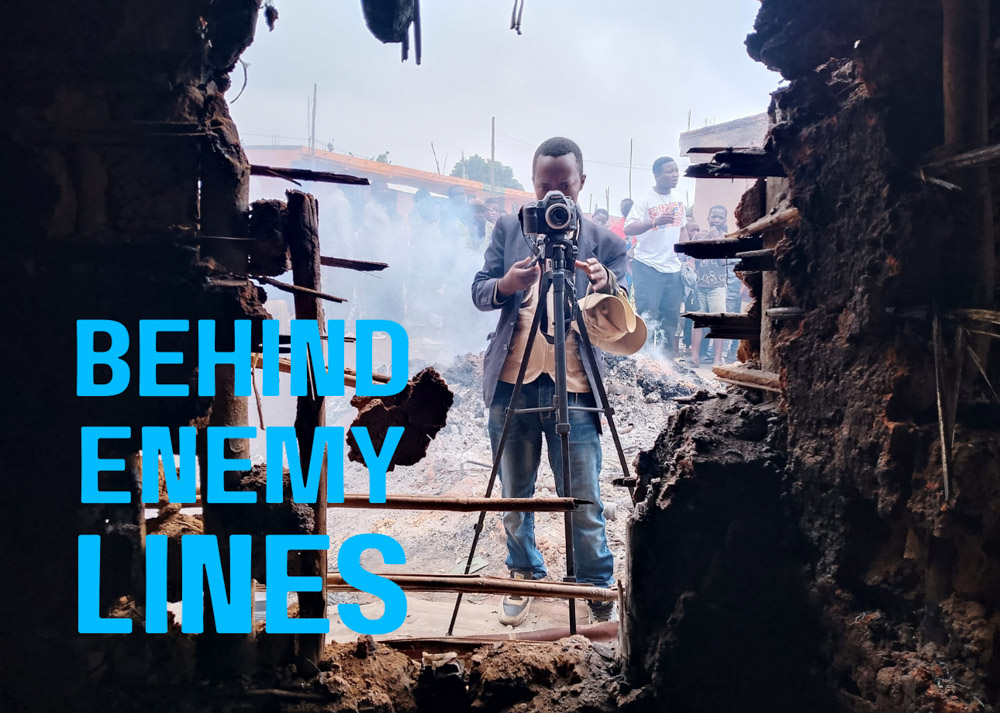
Censorship is also exercised through constant physical surveillance. “Putting a voice recorder or a camera out in the street is now just as dangerous as someone pulling out a gun,” explains another journalist. He recalls how a junior AFC/M23 officer stopped a colleague in the middle of the street, saying: “I’ve been told you wanted to do a report here. That sort of thing is forbidden. You must leave before I call the authorities.”
Another telling incident we come across involves RTNK (Radiotélévision Ngoma de Bukavu) and an AFC/M23 spokesperson. We hear how, on 27 February 2025, the day of the movement’s first major rally at Independence Square — a gathering that would later be marred by two explosions leaving at least eleven dead —, cameramen working for the rebels asked to go up onto the roof of the RTNK building to film the podium from different angles. One of the RTNK managers refused, citing security concerns, after which the cameramen reported the incident to their superiors. An AFC/M23 spokesperson then arrived at the premises himself, accompanied by a large number of officers. “Let’s put a stop to this nonsense once and for all!” exclaimed one of them. The manager had no choice but to allow them access to the roof and apologize.
According to the NGO Reporters Without Borders, which published an investigation last March into the M23’s detention of two journalists in shipping containers more than half (48) of all 78 recorded attacks (murders, assaults, arrests, detentions, enforced disappearances, threats) against journalists in the DRC, including the closure of entire media outlets, often including looting and ransacking, between January 2024 and January 2025 took place in the eastern DRC.
Contacted on several occasions, M23 declined to comment.
Survival tactics
Most newsrooms still operating in the region have come to adopt self-censorship as a survival strategy. Politics, security, even humanitarian issues are avoided in favour of social, cultural and environmental themes. “The problem is that even the environment can become political. Everything is sensitive if you want to delve deeply into your subject,” explains a journalist from Bukavu. Some community radio stations have even abandoned the participatory format that used to define their identity. “No more live calls – too risky.”
The trick is to avoid fundamental questions
Another survival tactic is to avoid the fundamental ‘who does what?’ question. Describing something that has happened, without writing down who is responsible, is a “trick that spares us the burden of fundamental questions”, says a reporter for a community radio station in Goma. “In this way we don’t have to mention the new occupiers, and face pressure that might make us end up defending them.” He ends our interview saying that “the sound of the truth can now hurt more than bullet wounds.”
Some who have struggled to continue real journalistic practice have paid a heavy price. Amisi Musaada, a journalist for online media outlet déboutrdc.net and a socially conscious musician, was abducted, held captive for several days and tortured before being released in July 2025, due to his articles critical of the AFC/M23 war. Honneur-David Safari, head of the media outlet La Prunelle RDC, was followed by unknown individuals and then abducted in late December 2025. He was found some days later, alive but in poor condition. Shortly before, he had given a platform to those who criticized the ‘forced marches in support of the AFC/M23 movement’.
The widely respected Radio Maendeleo station, for its part, has been summoned several times to the M23 movement’s Directorate of Intelligence Services (DSR) to account for the content of its programmes and the comments made by its guests. “We have been ‘invited’ four times to the DSR and once to the police. There’s nothing we can do; we just have to find a way to do our work in a war zone,” says a Radio Maendeleo journalist in Bukavu.
Journalists’ defence organisations like the Integrated Protection Partnership (IPP) and Journaliste en Danger (JED) have not been able to work in the eastern region for over a year now. A team member cites security concerns but also financial ones, particularly following the suspension of certain international aid programmes, including USAID. “Without resources, it becomes difficult to monitor the situation, particularly in the east.”
Treated as spies
The situation has impacted the relationship between those working in the region and the DRC authorities. Even journalists’ organizations, based in Kinshasa, now view the journalists in the region with suspicion, the latter say. The matter came to a hilt after the regional chairman of the National Union of the Congolese Press (UNPC) in South Kivu started working with the rebels. “He was forced”, journalists from the region say. A member of the organisation in South Kivu understands the severance of ties between the east and Kinshasa, calling cutting off the contact “logical.” The same unionist also highlights the difficulty national bodies face in conducting investigations in areas controlled by the AFC/M23.
Some reporters are suspect “because of where they live”
However, several journalists from the eastern DRC have also criticised what they perceive as an excessive closeness between their national professional organizations and the DRC’s authorities, saying that this is also to the detriment of balanced coverage of the situation. “Why don’t they talk about the threats and arrests we face when we go into areas controlled by Kinshasa?” asks a journalist based in Bukavu. She claims that some reporters are suspected of colluding with the rebels, only “because of where they live.” Several interviewees who have travelled to Kinshasa say they have been detained and questioned, their only ‘crime’ being that they live in areas under the control of the AFC/M23.
Security measures
When contacted by Ukweli, UNPC president Kamanda Wa Kamanda takes a hard line towards his colleagues in Goma and Bukavu. “I have also worked in conflict zones, but I remained professional. Journalists must defend their freedom. Either you are a journalist, or you are not.” Pressed on possible actions his union could take to help colleagues under threat, Kamanda points out that “some journalists have escaped the occupied zones and are receiving assistance in Kinshasa.” But they are treated like enemy spies? “The intelligence services' desire to gather information from these colleagues”, is the answer. “We are a country in conflict and understand that security measures are being reinforced.”
In a follow-up call with ZAM, Kamanda admits that even in the rest of the DRC, journalists often find themselves under pressure of political paymasters, including in the governing party. “This is an inheritance from the (dictatorial) Mobutu era. But we are on the right way. Our president just held a press conference where he defended free speech and support to media.” At the end of this call, Kamanda questions the background of the Ukweli reporter who first phoned him for comment, asking where he is from and from which ethnicity.
The union leader wants to know the journalist’s ethnicity
Minister for Communication and Media in the DRC, Patrick Muyaya, did not respond to multiple requests for comment.
Call to Action
ZAM and Ukweli produced this article based on reporting by courageous journalists who work for very little compensation. Our mission is to amplify their work and provide support. Contribute to ZAM’s mission by donating.