The propaganda emanating from Kigali is a warning: Rwanda’s regime now presents a global threat.
Within roughly a day of each other last August, two articles surfaced in Kigali’s media ecosystem that, read side by side, tell us that the war in eastern Congo is far from over. They also suggest that — if the Rwandan regime’s propaganda in these mouthpieces is to be taken seriously, as it should be — there is a risk that the conflict could expand.
The first, published in Kigali Daily News, under the headline "Is Kivu Leaving Kinshasa for Kigali After More Than a Century of Colonial Separation?", asks readers to imagine the map of the Great Lakes being redrawn. It portrays North and South Kivu, separated from the DRC’s capital, Kinshasa, by “1,500 km of jungle”, as “severing ties” with the distant, absent city and drifting back towards Rwanda, from which a “century of colonial separation” supposedly divided them in the first place. The provinces, we are told, already “function as” something other than the Democratic Republic of Congo.
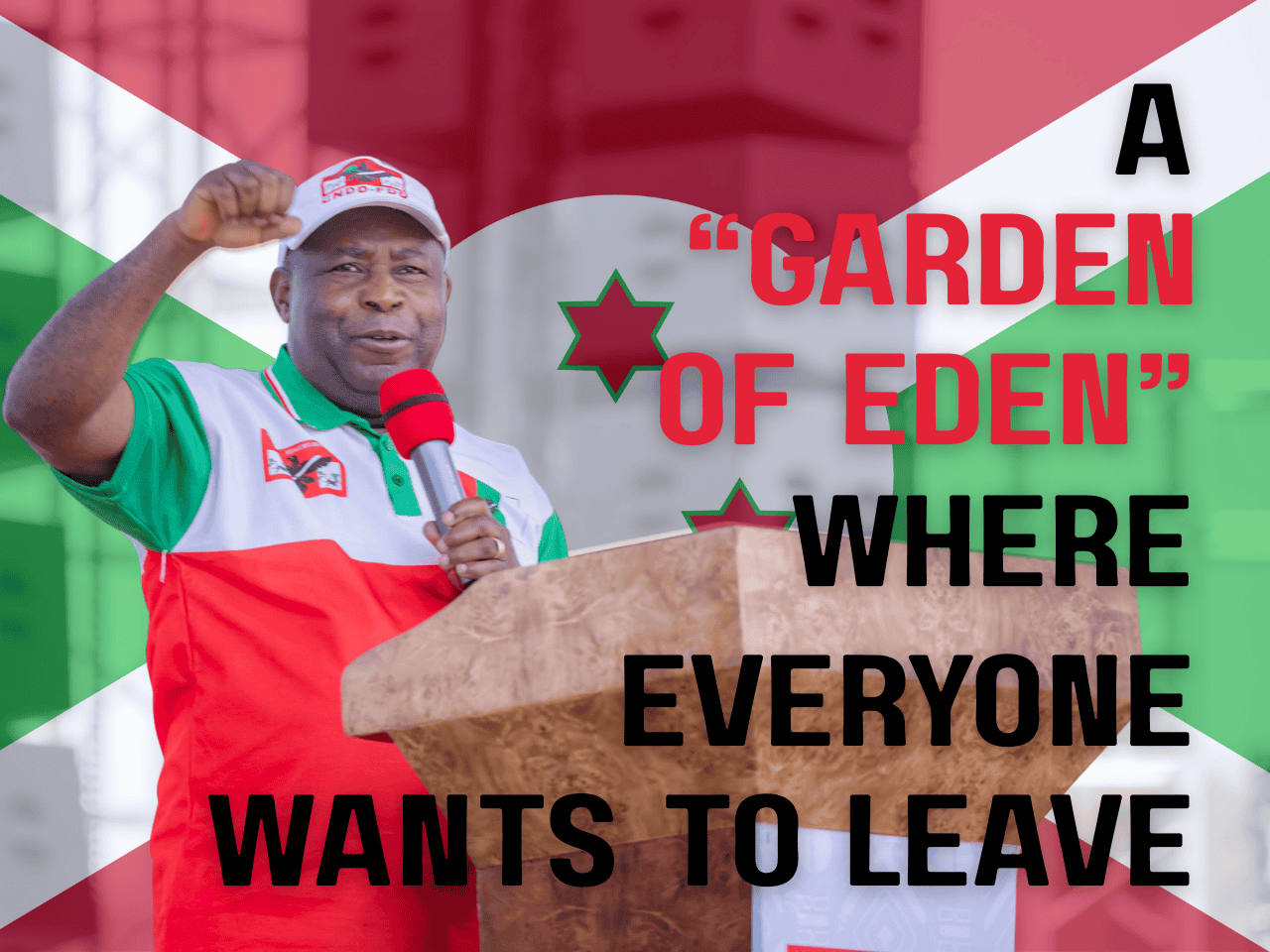
The second, carried by Rwanda’s other government mouthpiece, IGIHE, and echoed across the Rwandan-language web, concerns Rwanda’s other neighbour, Burundi. The piece rests entirely on the testimony of a self-described former FDLR officer. The FDLR is a Hutu militia associated with the 1994 Rwandan genocide and is now fighting the new, mainly Tutsi regime in the country. In his testimony, the anonymous former officer claims that Burundi’s ruling party, the CNDD-FDD, was fathered by the very perpetrators of the 1994 genocide against the Tutsi. He further claims that Burundi’s leaders remain closely tied to the FDLR to this day, naming a serving Burundian ambassador as a product of that lineage.
The “genocidaire” label
That is two of Rwanda’s four neighbours in the space of one week: the DRC, portrayed as an entity that unjustly claims ownership of a region that rightfully belongs to Rwanda; and Burundi, cast as a nest of génocidaires. The other two are not exempt from the frame, merely off it this week. Uganda, Kigali’s ally today, was accused of sponsoring the same Rwandan rebels, including the FDLR, when Rwanda closed their shared border for three years in 2019. Tanzania was cast as a protector of génocidaires in 2013 simply for suggesting that Rwanda negotiate with the militia rather than fight it. The label tracks Kigali’s needs, not the facts.
Where this week’s two targets coincide is in their association with Rwanda’s genocide. Not only should Burundi be punished for its alleged “genocidal” connections to the FDLR, but the FDLR is still present in eastern Congo too. So, if eastern Congo were to leave the DRC and become part of Rwanda, that would be doubly advantageous: it would also take the wind out of the “genocidal” FDLR’s sails in the region.
As a Rwandan, I have no illusions about the Rwandan, Congolese or Burundian governments. None has given its citizens much reason to hope that they can build better futures for themselves. But the cognitive warfare waged through these two pieces of Rwandan regime propaganda speaks, cynically, in my own language and in my name. I therefore feel a duty to warn about what they are saying.
Rwanda presents aggression as self-defense
Strip away the historical costuming and both pieces serve a single proposition, which lies at the core of Kigali’s diplomatic position. First, autocrat Paul Kagame’s regime cannot be asked to leave eastern Congo because the real threat there is existential and genocidal. Rwanda’s cross-border military presence is therefore framed as self-defence rather than aggression. And if eastern Congo was only ever severed from Rwanda by a colonial accident, then Rwanda’s proxy army, M23, occupying the region is not conquest but repair.
Secondly, if Burundi can be portrayed as génocidaire by descent, then the killers of 1994 can be cast as present in both countries.
The first article normalises the territory; the second criminalises the opposition.
A map of “Greater Rwanda”
But, as with propaganda, there is little truth in it. The Kivu article’s central claim is that colonialism tore the province away from a Rwanda to which it “naturally” belonged. This is the “Greater Rwanda” thesis, first presented in November 1996, at the start of the First Congo War, by Rwanda’s then-president, Pasteur Bizimungu. In a speech at the time, Bizimungu held up a map of a “Greater Rwanda” swallowing much of eastern Zaire and called for the region’s borders to be redrawn in Kigali’s favour. Thirty years on, the Kigali Daily News piece offers the same map, with better production values.
But there was no “Greater Rwanda” then, and there is no justification for one now. Gillian Mathys, the Ghent University historian whose Fractured Pasts in Lake Kivu’s Borderlands (Cambridge, 2025) is the most rigorous recent scholarship on this borderland, shows that at the close of the nineteenth century, the Rwandan kingdom was smaller than present-day Rwanda, not larger. The pre-colonial polities of the Kivus, including Bushi, Buhavu, and the Nande and Hunde chieftaincies, were not, as the Rwandan mouthpiece article claims, Rwandan provinces awaiting reunion. The kingdom’s western reach was contested and frequently repelled, while its own oral traditions record campaigns into Kivu that were halted by the forest and by the polities already established there.
The “integration” is occupation
Furthermore, the “colonial separation” the article laments has a specific date: the Kivu frontier settlement of 1909–1910. This was the same colonial cartography that produced every border in the Great Lakes, including Rwanda’s own. If we are to undo these colonial borders, then that should apply to all of them. Invoking such “undoing” only for Kivu, and only in the direction of Kigali, is not decolonisation but annexation. It is precisely this logic that the Organisation of African Unity sought to foreclose in 1964, when its Cairo Resolution (AHG/Res.16(I)) committed newly independent states to the borders they held at independence, a principle later carried into the African Union’s Constitutive Act.
As for the “organic” ties now binding eastern Congo’s Kivu provinces to Rwanda, the article describes an effect while concealing the cause. The integration is real, but it is the integration of occupation. In March 2026, the US Treasury sanctioned Rwanda’s most senior commanders, stating that M23’s territorial gains would have been impossible without Rwandan Defence Force (RDF) support, including GPS jamming, air-defence systems and drones. Successive UN Group of Experts reports have documented thousands of RDF troops inside Congo and their command over M23. A region does not “drift” towards a neighbour whose army fights inside it and whose proxy administers captured cities. It is pulled.
Guilt by association
The second narrative — the one about the FDLR militia and Burundi — is more insidious because it begins with a truth. The FDLR is rooted in the perpetrators of the genocide. It was formed in 2000 from elements of the former Rwandan army, the FAR, and Interahamwe militias who fled into what was then Zaire, now the DRC, after the genocide. But guilt is not inherited, and contact does not amount to guilt by association.
Burundi’s ruling party, the CNDD-FDD, was not born of the Rwandan genocide but of a national catastrophe. On 21 October 1993, Melchior Ndadaye, Burundi’s first democratically elected president, a Hutu, was assassinated by elements of the Tutsi-dominated Burundian army in a failed coup. The CNDD was formed in September 1994 as a Hutu-majority movement demanding the restoration of democracy and the de-ethnicisation of the army. The FDD was its armed wing, and the movement would eventually become today’s ruling CNDD-FDD. It fought in the ensuing Burundian civil war. Its origins therefore lie in a domestic Burundian struggle over majority rule, with its own logic, its own dead and its own resolution, reached through the South African-mediated ceasefire of 2002–2003 that ultimately brought it into Burundi’s transitional government.
What it is not is an offshoot of Rwanda’s genocidal Interahamwe. The Rwandan IGIHE piece, based on the “testimony of a former FDLR officer”, gets the formation date roughly right, September 1994, while assigning paternity to the Rwandan génocidaires who fled that same year. Correct date, false father.
The evidence is asserted, but it is not there
No honest editor would accept the sourcing in this piece either. The entire edifice rests on one self-identified “former FDLR leader”, whose account is delivered through a state-aligned outlet; a companion piece rests on a single returnee who went back to Rwanda in 2023. Such “defector testimony”, processed through state media, is among the least verifiable forms of evidence: self-interested, unfalsifiable, impossible to cross-check and structurally vulnerable to coaching. A “cooperation agreement signed in Bukavu” is asserted, but no document is produced. Names, dates and unit designations are piled up to simulate the texture of evidence without providing its substance.
No “existential threat”
The regime in Kigali also manipulates global opinion when it labels the FDLR “génocidaires” and presents it as an “existential threat”. Yes, the FDLR militia in eastern Congo is certainly a threat. But a major threat, let alone an “existential” one, it is not. The group’s own propaganda claims to have 10,000 or 20,000 soldiers, but the UN considers those estimates unreliable. Its Group of Experts reported in July 2026 that the FDLR’s actual strength was roughly 3,000 to 4,500. This is a degraded, ageing force, repeatedly reduced over three decades, with half its combat strength reportedly neutralised in a single 2009 offensive. It finances itself through charcoal trading, checkpoints and kidnapping. It is a genuine menace to civilians in the Kivus and a real irritant to Rwanda. It is not a genocide-in-waiting capable of overrunning a state.
A citation trick in the two pieces is a hallmark of Rwanda’s propaganda. Kigali amplifies the passages in each Group of Experts report that document FDLR collaboration with elements of the Congolese army, but never cites the passages documenting the presence of thousands of Rwandan troops inside Congo and Rwanda’s command over the M23 militia. The machine resolves the contradiction by simply never printing the second half.
Eastern Congo is not Rwanda’s to police
While the FDLR exists, while it has in fact attacked Rwanda, and while elements of the Congolese army have shamefully collaborated with it, none of this makes eastern Congo Rwanda’s to police. A neighbour’s internal armed groups are addressed through cooperation and international mechanisms, not unilateral invasion and proxy administration. Article 2(4) of the UN Charter prohibits the use of force against another state’s territorial integrity, while the narrow exception for self-defence has never licensed the occupation of a neighbour’s provinces and the installation of a client authority. In 2005, in DRC v Uganda, the International Court of Justice rejected this security justification precisely, finding Uganda’s presence in the DRC’s Ituri region unlawful. In 2022, the Court ordered Uganda to pay $325 million in reparations, which Uganda is still paying in instalments.
Lawful channels to address the FDLR threat also exist. The militia’s neutralisation is itself the subject of an agreed, sequenced and internationally supervised process under the 2025 Washington framework, alongside the Luanda, Nairobi and Doha tracks, MONUSCO, sanctions regimes and the Group of Experts. Every instrument Rwanda needs to address the issue already exists, and Rwanda has access to all of them.
It is therefore remarkable that it is Kinshasa, rather than Kigali, that has gone to court. On 26 June 2026, the DRC filed a case against Rwanda at the ICJ under the Genocide Convention, the Convention on the Elimination of All Forms of Racial Discrimination and the Convention against Torture. It has also sued Rwanda at the East African Court of Justice and made referrals to the ICC. One state took its grievances to courtrooms; the other took them to the battlefield and its troll farm.
As long as there is an “existential threat”, the withdrawal clock doesn’t start
The timing of the two mouthpiece articles this month is not incidental. Under the Washington framework, Rwanda’s obligation to withdraw from eastern Congo is linked to the “neutralisation” of the FDLR. As long as the FDLR is portrayed as an “existential threat” and its supposed sponsors as “genocidal”, the withdrawal clock never has to start. A journalist who documented Rwanda’s involvement in Congo as what it has long been described as, an invasion, has already paid for it. The same Rwanda Classified investigation mentioned above began with the death of Rwandan journalist John Williams Ntwali, who had investigated the presence of Rwandan troops in Congo.
The war for the Kinyarwanda mind
While the international community is targeted with laundered deniability, a plural-looking press, a dozen Western PR firms, selective UN citations and a narrative in which “aggression” becomes “counter-genocide”, Kinyarwanda speakers are offered incitement, and permission to be incited. The narrative presents invasion as protection, a captured city as a homecoming and a critic as a génocidaire. It turns our ethnolinguistic identity into a weapon, simultaneously to enrage and endanger us.
The Banyarwanda — Kinyarwanda speakers — are a supra-ethnicity of some 15 million people spread across Rwanda, Burundi, Uganda, Tanzania and the DRC. Kinyarwanda-speaking communities have lived in eastern Congo since before the present borders existed. Their contested citizenship, the “Banyarwanda problem”, is a genuine century-old grievance rooted in fragmentation and imposed borders, not an invention.
Rwanda is lighting an ethnic powder keg
This is the powder keg Rwanda is lighting. By collapsing language into ethnicity, ethnicity into nationality, and nationality into loyalty to Kigali, the operation turns a real community into a fictional fifth column. If Rwanda claims to defend “Kinyarwanda speakers”, then every Kinyarwanda speaker is presumed to be, and must be, loyal to Rwanda’s government. The effect is to make every Kinyarwanda speaker in the DRC a suspect in their own country. This endangers Congolese Tutsi more than Rwanda’s propaganda protects them.
None of this will look unfamiliar to anyone who has followed tyrants’ wars through history. Presenting language as ethnicity, ethnicity as nationality, nationality as loyalty to a mother state, and that loyalty as a licence to cross a border “in defence of your own” is a script used by Nazi Germany a century ago and now also by Moscow in Ukraine. Russian speakers in the Donbas are Russia’s Banyarwanda: a real community with a real history, conscripted into a fiction that recasts invasion as rescue and a sovereign neighbour as a nest of “fascists” with no claim to its own land.
Authoritarian script
The costuming differs: génocidaire for fascist, a colonial map for the myth of a shared ancient homeland, an FDLR defector for a Donbas “referendum”. But the syllogism is identical, as is its function: to manufacture, in advance, the moral permission for a conquest that the aggressor intends to narrate as a homecoming. It is the oldest authoritarian script there is. Kigali is simply its most fluent current author, working in a language the world’s fact-checkers cannot yet read.
It works partly because the terrain is unguarded. Researchers developing some of the first Kinyarwanda propaganda-detection tools have found that major platforms and commercial AI systems are essentially unable to recognise manipulation in Kinyarwanda: the fact-checkers, moderators and models that flag such content in English or French cannot see it here.
The regime says things in Kinyarwanda it would never say in English
The Kinyarwanda public sphere is among the least policed and most captured, which is why the regime can say things in Kinyarwanda that it would never risk saying in English. It is also why the first victims of the Rwandan autocracy’s information war have always been Kinyarwanda speakers themselves, denied an honest account of a war waged in their name.
None of this is improvised. The 2024 Rwanda Classified consortium mapped an influence machine running from lobbyists in Washington and London to spyware and an Israeli private psy-ops outfit. Clemson University’s Media Forensics Hub identified at least 464 coordinated accounts flooding discussion of that investigation with pro-Kagame content, much of it AI-generated. Kigali Daily News presents itself as independent while recycling material from IGIHE. Together with English-language mirror sites and #RwOT (Rwandans on Twitter) amplification, these outlets form a distribution system that launders state messaging into the appearance of a free press. It is one voice with many mastheads.
War makes reform impossible
As said above, the Congolese and Burundian states have failed their own citizens too. But a state that misgoverns its own people and a state that, on top of that, invades and annexes its neighbours are not the same order of wrong, and only one of them makes the other’s reform impossible. You cannot build accountable government in a province administered by a foreign proxy.
Displacement crisis
Moreover, and crucially, the consequences extend far beyond North and South Kivu. Eastern Congo is already the site of one of the largest displacement crises in the world. Internal displacement peaked at more than seven million people in 2025, the highest figure ever recorded in the country. The Norwegian Refugee Council now ranks it as the world’s second-most neglected displacement crisis, behind only Sudan, for the tenth year running.
The minerals reach consumers who imagine the war has nothing to do with them
A Kivu held indefinitely by force, in a war without settlement, becomes a permanent engine of displacement, and the people it pushes out do not stop at Kampala or Nairobi. They move towards the same European capitals now debating how many more arrivals their politics can absorb. The minerals beneath the contested ground, including coltan, tantalum, tin and gold that Rwanda exports in volumes its own soil cannot explain, enter the supply chains of the very consumers who imagine this war has nothing to do with them. The comfortable distance between a reader in Brussels and a checkpoint in Goma is an illusion. The trade routes and the migration routes both expose it.
A working template
There is a larger stake still, and the Russia comparison makes it unavoidable. If a state can seize a resource-rich part of its neighbour through a proxy, brand the seizure as decolonisation and the resistance as genocide, and pay no price for either, that is not a Central African anomaly. It is a working, demonstrated and exportable template for any government seeking to redraw a border after learning that the rules against it are enforced selectively, or not at all.
Europe grasped this instantly when the aggressor was Russian and the victim European. It has been slower when the map is African, even as its own institutions feed the machine. The European Parliament voted 443 to 4 to suspend the EU’s critical raw materials partnership with Rwanda until Kigali ends its interference in Congo. The Commission placed the partnership “under review”, but has so far kept it alive rather than terminating it, even as the UN documents at least 150 tonnes of Congolese coltan being laundered through Rwandan supply chains every month. The question is not only what Rwanda is doing. It is what Europe is financing while it looks the other way.
Licensing a hegemon
Which leaves the question the piece has so far only implied: what if it works? A Rwanda that normalises this method has no obvious reason to stop at Kivu. It is already a multi-theatre security actor, with troops in Mozambique, a footprint in the Central African Republic, and surveillance and mercenary exports across the continent, projecting force and deniability far beyond its borders while Western capitals applaud the stability it sells. Grant Kigali its Kivu on its own terms and you have not ended a regional war; you have licensed a hegemon and taught it that the licence is cheap. That is the trajectory towards which a stalling peace process is quietly bending, which is why the withdrawal clock that never starts is not merely a Congolese problem.
It is everyone's.
Call to Action
ZAM works towards a new equal relationship between Africa and Europe. Contribute to our mission by donating.