A “fake and damaging” solution to the climate emergency
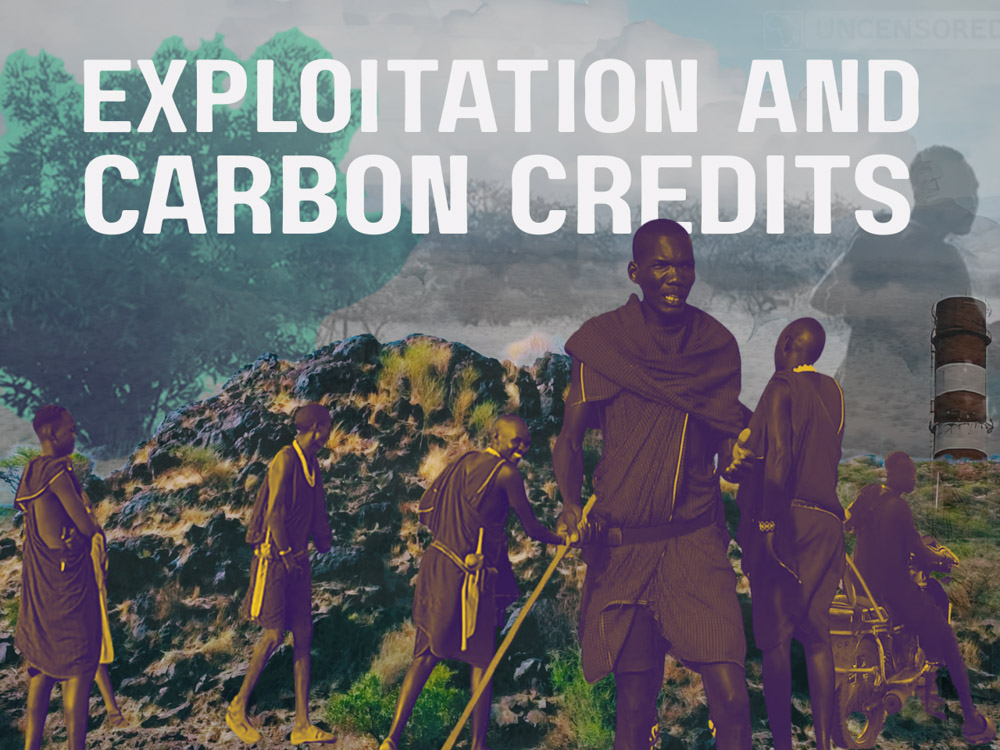
In the documentary Carbon Colony, journalist Martin Siele, working with ZAM publishing partner Africa Uncensored, reveals how Kenyan elites orchestrated an illegal land grab spanning thousands of hectares belonging to the Ol Donyo Nyokie Community Ranch under the guise of a carbon project.
The controversy surrounding Ol Donyo Nyokie Ranch raises urgent questions: Was this merely a land grab? Were the carbon projects sound? Would preserving the trees and altering cattle-grazing practices genuinely help mitigate the global climate crisis? Were the people of Ol Donyo Nyokie Ranch not the very reason the area remained preserved? And how does a local land grab by Kenyan political elites intersect with the global carbon credit offset market designed to address climate change?
ZAM spoke with Siele, with Follow the Money's investigative journalist Mira Sys, co-author of the book Wie betaalt mag vervuilen (If You Pay, You May Pollute) and with Joanna Cabello, head of research at the Dutch-based Centre for Research on Multinational Corporations (SOMO).
In the interviews, Siele, Sys, and Cabello shed light on a chaotic picture marked by ineffective land-based carbon offsets, the reinforcement of exploitative neo-colonial structures, and the abuse of power by local political opportunists. Science urges us to address the climate crisis, the interviewees argue, but the solutions must be both non-exploitative and effective. They also question whether current practices constitute solutions at all.
“If you pay, you may pollute”
Carbon credits are paper promises that, somewhere in the world, one tonne of carbon will be removed from the atmosphere for each credit, explains Mira Sys. This may occur either through emitters, such as factories, reducing their pollution, or through activities such as planting trees. Once in circulation, carbon credits become profitable, tradable commodities. It is at this point that the conflicting interests of industry actors (see box) mean that the promise of genuine carbon removal is rarely adequately fulfilled.
Joanna Cabello, who has been researching carbon offset markets for a decade, has a particular interest in Kenya as one of Africa’s biggest players in the land-based carbon offset market. She highlights a disturbing finding from recent SOMO research in the country: land-based carbon offset projects there now encompass almost as much as Kenya’s total arable land. The finding comes from a database compiled by Cabello’s Kenyan colleague, Juliet Kariuki, of 36 land-based carbon offset projects in the registry of carbon certifier Verra. Of these 36 projects, 30 are foreign. Together they span more than 5.4 million hectares, whilst Kenya’s arable land spans 5.8 million hectares. The same goes for the audit companies: three quarters of the audit companies employed by the projects are also headquartered in the Global North.
An industry dominated by foreign actors indirectly controls significant portions of Kenya’s land
While carbon offset project developers do not own the land on which their projects are situated, they do own the rights to the carbon stored within it. Indirectly, therefore, these developers exert control over what happens on the land. In effect, this means that an industry dominated by foreign actors indirectly have influence over significant portions of Kenya’s land.
The players
Project developers create projects that capture carbon through reforestation or nature preservation. They liaise with local communities and key individuals on the ground in the countries and regions where these projects take place. ZAM’s interviewees say that project developers risk overestimating the carbon credits they generate, since the more carbon they are believed to remove from the atmosphere, the higher their remuneration becomes.
Certifiers, such as Verra and Gold Standard, register the existence of the project and issue the carbon credits for buyers to purchase. They receive a commission per credit issued, thereby also risking overestimating the amount of carbon credits they certify.
Auditors confirm that the project generates carbon credits and determine how many are produced. Their audits are intended to provide oversight and accountability; however, because auditors are hired by certifiers and paid by project developers, they may have an incentive to deliver favourable outcomes.
Buyers of carbon credits, often multinationals such as Shell, Gucci, or Netflix, seek to obtain the highest number of carbon credits for their money.
In this way, all the actors mentioned above are incentivised to overestimate carbon credits. The lack of regulation, ZAM’s interviewees say, further results in a lack of accountability.
All players in the industry face incentives to overestimate
Neo-colonialism
While the countries of the Global North bear the greatest historical responsibility for climate change due to their high levels of CO₂ emissions, most land-based carbon offset programmes are located in the Global South. In this way, the Global South ends up paying for problems originating in the North. Kenya’s government’s decision to cede control over what happens on the country’s land to foreign carbon offset project developers is therefore an example of a new form of neo-colonialism: actors from the Global North, primarily motivated by profit, use the South’s resources with little to no benefit to the communities and people where those resources are generated. “This is a new commodity that the Global North extracts from other countries, that is not theirs to take,” says Mira Sys.
Siele, Sys, and Cabello found that, in most cases, local communities are neither properly informed nor consulted to secure free, prior and informed consent. In many instances, these communities enter into contracts of paralysing duration, ranging from 30 to 100 years. They also bear the burden of risks associated with the loss of stored carbon due to external factors, such as drought.
But often, it does not even stop there. The Ol Donyo Nyokie ranch in Siele’s documentary faced an additional rip-off due to an alliance between the project developers and local ruling elites, who orchestrated a land grab through their involvement in the project. Similarly, in Sys’s and Gijzel’s book, communities living near Mount Elgon in Uganda hold ongoing grievances stemming from land loss that began 30 years ago. The Dutch carbon offset initiative, the FACE Foundation, with support from a Ugandan foundation, began planting trees to offset carbon on land whose ownership was still contested. This excluded communities from accessing land on which they had previously farmed. In the three decades since, violent and deadly encounters have repeatedly taken place between residents and Ugandan environmental security forces.(1)
“We call it a fake solution”
“We call it a fake solution,” Mira Sys and co-author Ties Gijzel say when asked to summarise the phenomenon of the carbon offset market. They see the entire industry as ineffective and, often, damaging ‘greenwashing’ — first, because the conflict-of-interest-ridden sector cannot be trusted to deliver meaningful carbon reductions; and second, no less importantly, because of the harm these projects cause to farming and rural communities in the Global South. In their book, Sys and Gijzel compare carbon credits to the infamous “letters of indulgence”: paper entries to heaven that the Catholic Church in the Middle Ages sold for its own profit.
SOMO’s Joanna Cabello stipulates that the rural Global South may traditionally have done much more to preserve the environment. “If forests are still standing, it is mostly because of the communities that have cared for them,” she says, adding that it might be better if carbon offset projects focused on stopping deforestation from mining sites. “But that’s not profitable. So they go to community lands.”
“If people knew how this allows the exploitation of others, they would be against it”
When asked whether carbon offset projects could be made non-exploitative, Cabello responds: “No. That’s a contradiction in terms.” Reiterating that land-based carbon offset projects enable extraction and pollution elsewhere, she concludes: “If people knew how their carbon storage enables the exploitation of others, they would be against it.”
- The Ugandan chapter was co-authored by Emmanuel Mutaizibwa, a member of ZAM’s partner, the NAIRE network.
Watch the full interview with Mira Sys here.
Watch the full interview with Joanna Cabello here.
Watch the documentary Carbon Colony, by Martin Siele with Africa Uncensored here, and the corresponding article here.
*Siele, Sys and Cabello focus on land-based carbon credits, which differ from carbon offsets generated through technological solutions. In the latter case, carbon credits are produced through investment in technical environmental projects, for instance when wind energy reduces carbon emissions.