
The NGO world in Africa — while often performing important work in healthcare and other public services — has also been criticised for its dependence on donor agendas and the practice of tailoring grant proposals to fit donor themes and priorities. Satirists such as Elnathan John have lampooned these and other habits of many NGOs, including their, likewise donor-influenced, reluctance to challenge authority. The NGO sector’s routine of holding “endless cycles of workshops” was also featured, unflatteringly, in ZAM’s recent investigation into elections in several African countries.
But in early September, signs of change began to emerge across the sector.
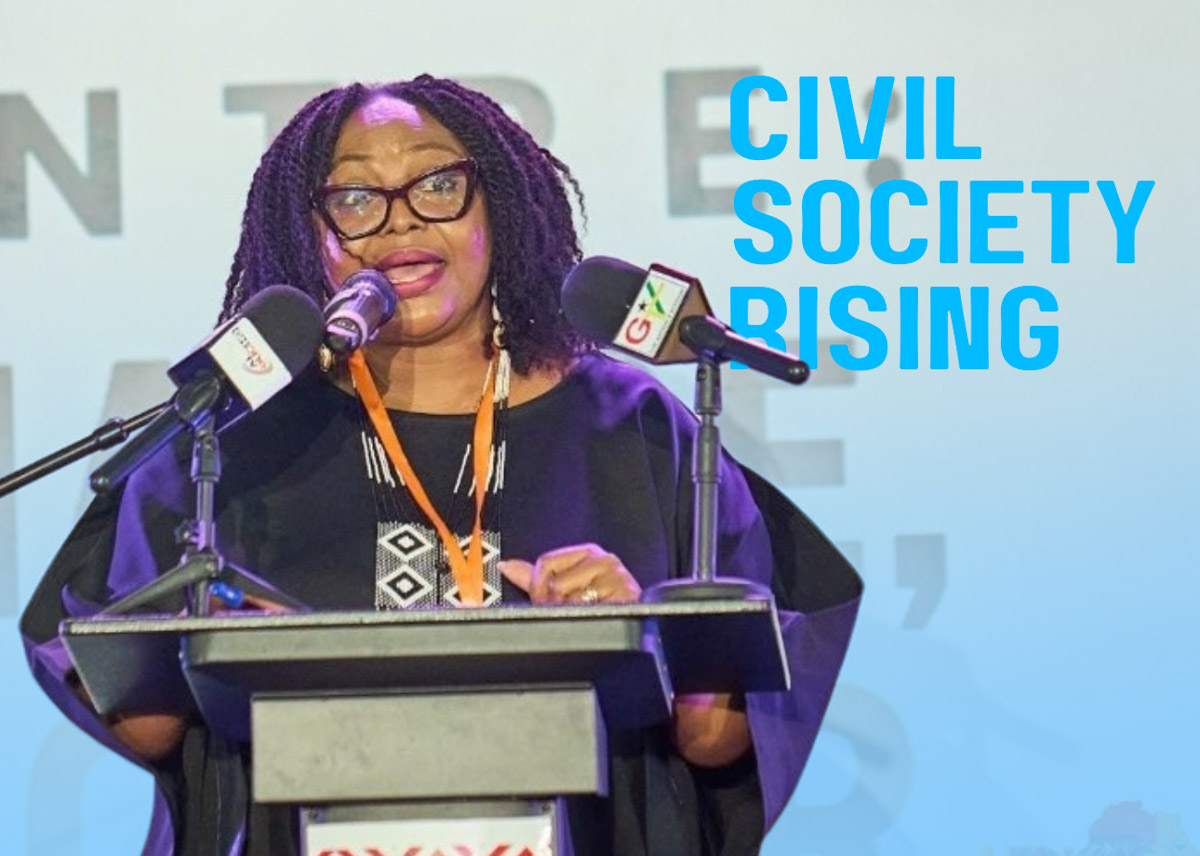
The new wave, already simmering for some time, was voiced by activists who have had enough of the lack of grassroots power to effect change in their countries. “We are ready to push back,” said protagonists who highlighted the need to hold power, whether local or foreign, accountable, at the conference “Africa at the Centre: Leading Change, Shifting Power”. The three-day event, held from 1 to 3 September in Accra, Ghana, brought together more than 200 civil society leaders, funders, policymakers and development experts from 30 countries.
“One organisation had already rejected a donor grant”
Interviewing participants and organisers, Nigeria’s Premium Times reported afterwards that one organisation in Kenya had already rejected a particular donor grant because it prescribed work the organisation was not yet prepared to undertake, while other priorities felt more urgent. Premium Times also highlighted, by contrast, the abandonment by some donors of organisations providing urgent healthcare and other services. The report focused in particular on the Trump administration’s termination of USAID in January 2025, which led to the closure of hundreds of clinics, large-scale layoffs of healthcare workers and serious disruptions to infectious disease control.
Monitoring government
But Trump’s USA, it was highlighted, was not the only source of funding cuts to civil society. The same Premium Times report quoted Oyebisi Babatunde Oyebisi, head of Nigeria’s NGO Network, warning that some donor countries are increasingly directing funds to governments rather than civil society organisations. This was problematic, Oyebisi argued, because African governments are precisely the actors that civil society should be able to hold accountable for issues such as corruption and illicit financial flows out of the continent. “Governments cannot be expected to fund the organisations that monitor them,” Oyebisi said. “Independent civil society groups need resources that do not come from the governments they are holding accountable. You don’t expect my government to give me money to monitor it.”
The calls at the conference, therefore, were not only for greater agency and decision-making on the African side, “to prioritise the needs of our communities” rather than donor-generated themes, but also simply for more money, this time with no strings attached. But the question remains: can NGOs really tell donors what to do? Doesn’t the one holding the purse strings hold all the power?
“The system has placed us in a position of dependence”
“That’s precisely what we need to change,” says Nana Asantewa Afadzinu, executive director of the West Africa Civil Society Institute, which hosted the Accra conference. “The system has been set up so that we are always in a position to be fed. It places us in a position of dependence.” Donors themselves may not want to change the system they designed, “but you must push back”, she adds. “Slavery and colonialism would never have stopped if there hadn’t been any push back. Africa has a lot of resources. We are the richest continent in the world. But our leadership needs to manage those resources. If they do that [properly], the West will have no other option.”
Not mincing words about African political elites who sell out the continent’s resources in exchange for a comfortable life for themselves, Afadzinu explains that the conference was ultimately about “citizens rising up” against such practices. “We engaged with where we should be going, what we should be doing, how we should hold our leaders to account. We have to build solidarity and work together. As Africans. Across our cultures. And really push our governments to do the right thing for their people.”
Social justice agenda
Afadzinu admits that it is “not a magic wand”, and that organisations will have to work on both ends: strengthening themselves while engaging donors “all at the same time, yes, it’s a chicken and egg situation. But we have to work systemically. Engage all sides: our own governments, donor countries, private philanthropy. And local philanthropy too. We ourselves must strengthen our own giving towards a social justice agenda. And work with the media. We need investigative journalism that gives us evidence to push our cases, independent media that can really hold government accountable. And hold us accountable as well.”
“Citizens need to follow the money”
One example of the kind of citizen activism that should be supported was offered at the conference by Nigerian NGO head Oyebisi, who said that “civil society groups need to follow the money”. For instance, he said, in cases involving building projects such as roads or clinics — which often remain unfinished or never become operational because funds have been diverted — “citizens need to be able to track who the contractor is, and whether it gets finished, with a mechanism to flag problems and get a response.” He added that citizens should also be supported to challenge corruption at higher levels of society, with the ultimate goal of encouraging African governments to improve their tax systems and block illicit financial flows.
Encouraging responses
Asked whether Western donors would really agree to start funding such initiatives, Nana Afadzinu said that she is hearing “encouraging responses”. “Many in the philanthropy sector are also worried about right-wing populism rising in the West and globally. The world needs more social justice, an equitable international system and an Africa that offers prospects to its people. An Africa led by responsible leaders with agency. Both in civil society and in government.”
Call to Action
ZAM works towards a new equal relationship between Africa and Europe. Contribute to our mission by donating.