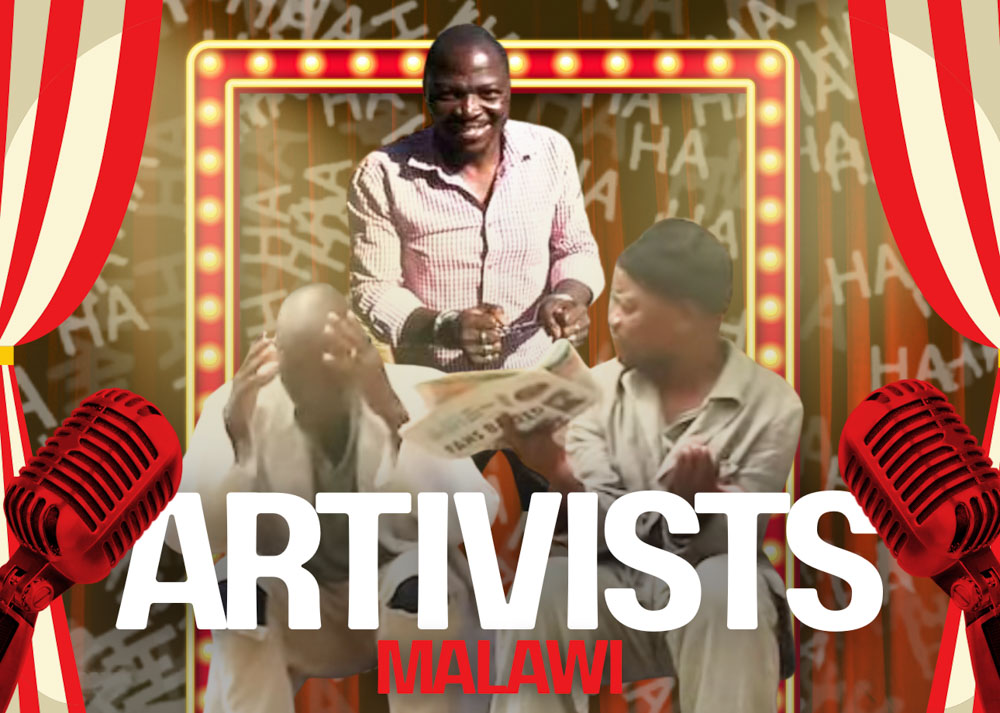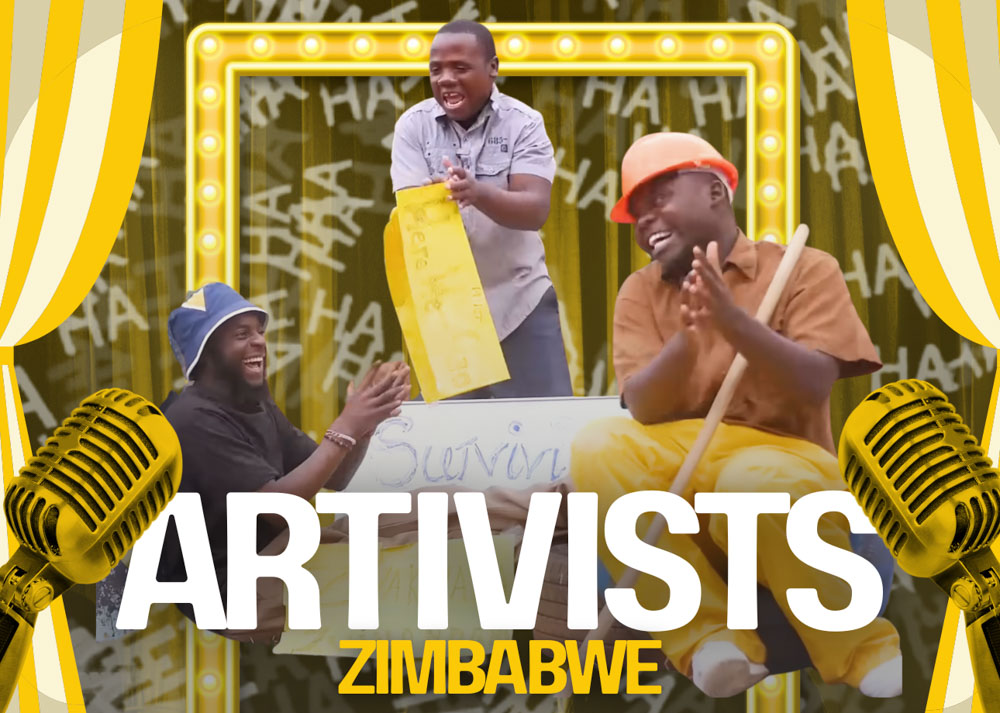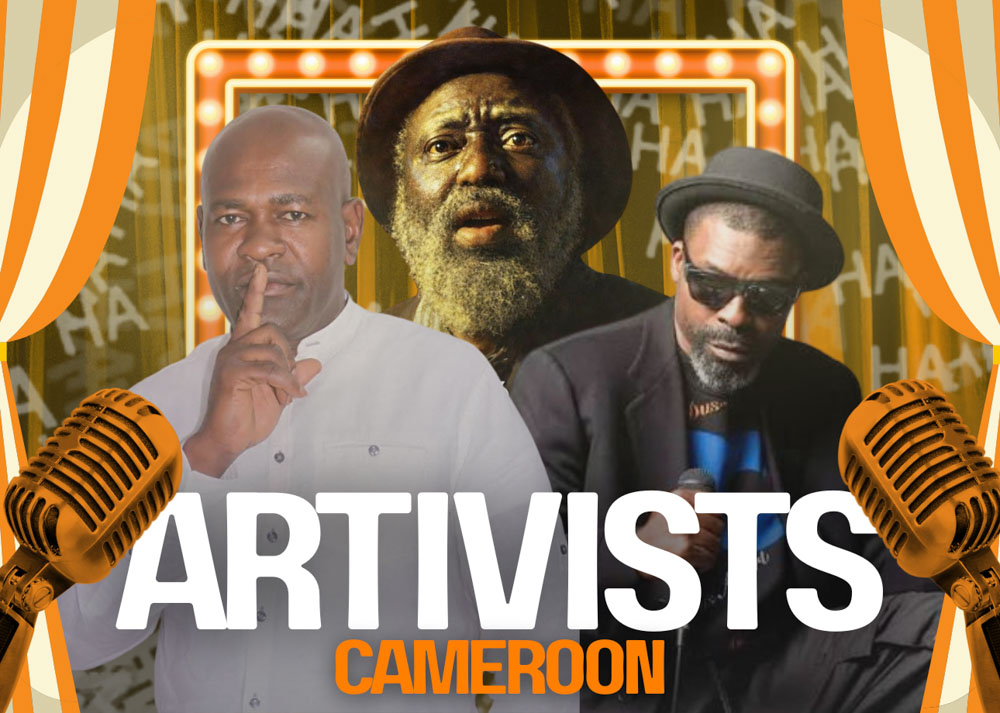

Samantha Kureya was abducted and tortured, yet came back to continue her comedy show. Satirical performer Bon Kalindo was arrested fifteen times. Cartoonist Mustapha Bulama was slammed by Nigeria's First Lady, and the fun-poking newspaper Le Popoli recently emerged from a six-month publication ban. But their following on social media, especially among the youth, keeps increasing. A team of investigative journalists in Zimbabwe, Malawi, Nigeria, and Cameroon discovered how the power of laughter, especially laughter at authorities, is undermining "politicians who use big words to confuse the public" across the African continent.
President of the Poor
In Malawi, performer and activist Bon Kalindo aims to dismantle the "political class", as he calls it, even though he was once part of it himself, serving on various opposition tickets. But after experiencing how most politicians in his country close ranks around their privileges, he abandoned government five years ago, apologising at a press conference "for campaigning and making Malawians have faith in a system that has broken their livelihoods." He now focuses fully on making his compatriots laugh at political players and their promises. When "one million jobs" were announced, he had his comedic character, Winiko, looking for them in empty cooking pots and along dusty roads.
“Politicians are cowards”
Like many satirists, he doesn't have to look far for such material amid the "big words" uttered by the powerful. At the same time, his "ordinary man" translations, says one analyst, "give Malawians a conceptual vocabulary to talk about complex institutional issues such as poverty, corruption, and poor governance."
Meanwhile, the politicians seem to be at a loss as to how to deal with Kalindo, who nicknamed himself the "President of the Poor". Fifteen arrests have only made him more popular among his vast social media following, while those feeling threatened, in contrast, display an astounding lack of a sense of humour. When he was "summoned" by certain politicians in government at the time of the 2025 elections, they "interrogate(d) (me) why I call myself the President of the Poor", Kalindo told ZAM's Josephine Chinele. "They asked if this implied that I had ambitions to become a president myself."
In his ZAM interview, Kalindo called politicians "cowards" for this attitude. "The fear of others is why they don't arrest each other for corruption." Amid the sharp jokes, Kalindo also organises marches under the slogan Malawi Sali Bho (Malawi Isn't Fine), which attract tens of thousands of participants.
Pontificating officials
A comedic "ordinary man" character, like Kalindo's Winiko, is also a national treasure in Cameroon, where entire families still laugh at "Kankan", full name Dieudonné Afana Ébogo, who, though he died in 1997, continues to be a legend for taking the mickey out of pontificating officials in his country's bureaucracy. His sketches illustrated the ordeals citizens have to negotiate every time they needed to deal with state administration, whether to obtain an ID card, a driver's licence, or other official documentation. Though good-natured and never promoting any activism against the state, which would be dangerous in Cameroon's dictatorship, Kankan's sketches still make entire families, and even classrooms, laugh. All Cameroonians know the "disconnect between citizens and public service hailing back to colonial times", as ZAM's Elizabeth BanyiTabi put it.
Singers eviscerate the country’s gerontocracy
Cameroonians also know that, if you want to do real protesting, you better do that from exile, as satirical protest singers Longue Longue (1) and General Valsero have discovered after eviscerating the country's "gerontocracy" and denouncing how its ageing leadership "kills the young". Nevertheless, the buzz generated by the singers and influencers, combined with the memory of "Kankan", contributed to creating the biggest, and most violently suppressed, protest against fraudulent elections in the country's history last year.
In an interview with BanyiTabi, Le Popoli editor Paul Louis Nyemb Ntoogue, more commonly known as "Nyemb Popoli", also tips his hat to "Kankan". Referring to the six-month ban his authority-mocking newspaper was recently slapped with by the government, he says he "conjures up in his head" the sketches the great comedian might have written on such matters. The memory of him, and other "founding fathers" of humour, gives him the strength to "keep holding up a mirror to government", Nyemb says. "Today I think our paper has helped to dent the dictatorship. More people can speak out than before. We stood the test of time."
Absurdities
For another country that regularly disappears and tortures opponents, Zimbabwe's comedians seem to be particularly vocal, even taking on the work of providing actual news through TV shows aired on the internet. Young followers of these highly popular shows, interviewed by ZAM's Mukudzei Madenyika, say that "the avenue to get independent news are these content creators," and that the only alternative is "state propaganda." "It's easier on the soul to be informed whilst at the same time finding humour in the absurdities of current affairs," said one.
Comedians dress as police officers, kicking citizens
Zim's Magamba TV, for example, has aired regular, satirical updates on the constitutional amendment bill that extends President Emmerson Mnangagwa's rule to 2030, pushed through by the ruling party ZANU-PF in July. The Magamba reels, on various social media platforms such as TikTok, overtook the dry and vague government summaries in established media.
Zimbabweans also regularly flock to watch sketches that show citizens being bullied by ruling party militants, or kicked by police, the same comedians, but in uniform. A favourite thread in these sketches is the portrayal of such characters actively beating up unsuspecting people, once for allegedly saying the word "government": doing that can, after all, only be critical.
Though comedy actress Samantha Kureya was abducted, tortured, and made to drink sewage water by masked men on one occasion after such a sketch, that experience is not keeping her down. She, too, is back doing satire at Bustop TV, which, together with fellow shows like Magamba TV and comedians like King Kandoro and Taffy the Man, counts a following of a sizeable proportion of Zimbabwe's urban, internet-savvy, youth.
Talking parrot
A ragingly popular rap artist known as Fresh Emir, with a current affairs talk show called Talking Parrot, is meanwhile taking northern Nigeria by storm. ZAM's Theophilus Abbah reports how Emir's music enthrals the youth in the impoverished region as he takes no prisoners, "denouncing corruption, elite enrichment, lack of education, youth frustration, as well as drug use, crime and violence". Not only has the artist established a reputation as a "hero, freedom fighter, and voice of the masses", he also appeals to the region's oral tradition in the original Hausa language. "The resulting audio," writes Abbah, "delivers parrot-like truth-telling, urgent calls to action, and poetic rhythm." Abbah also quotes a reviewer who explains Emir's close to one million views on YouTube through his unique style, with distinctive verse arrangements and a "baritone voice" that "resonates even within conservative Hausa society."
“In Nigeria, if you don’t laugh, you’ll cry”
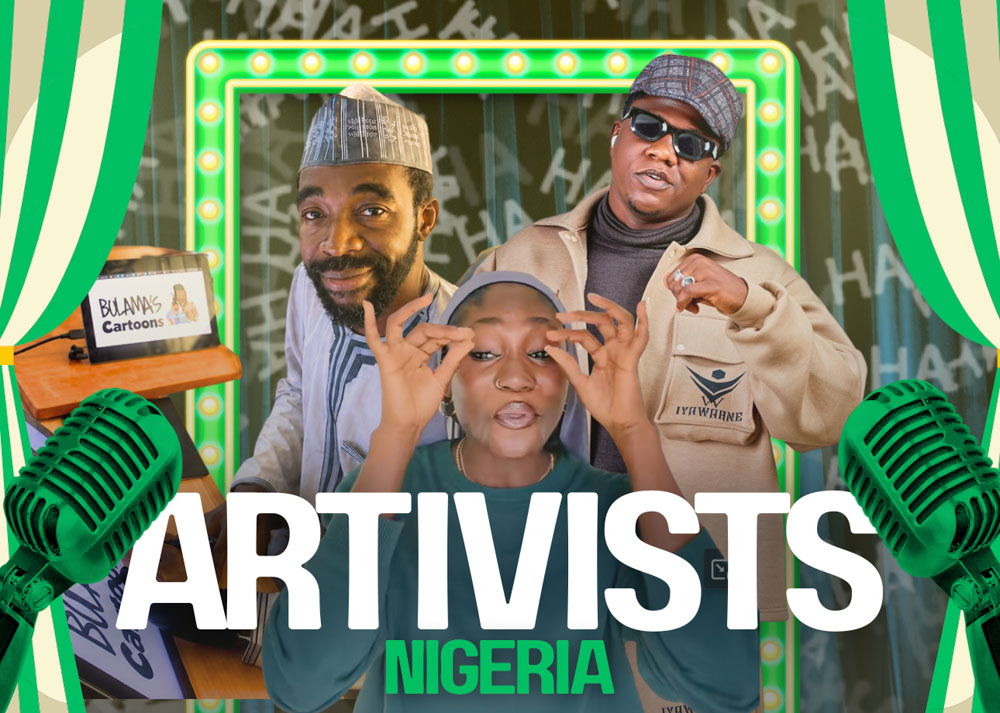
In Nigeria's more southern parts, around Lagos and the capital, Abuja, influencer Hauwa Lawal rocks "conservative society" in more ways than one. Taking on "aunties who want to marry you off" as much as a "ruling party that you want to flee to help save Punch the monkey in Japan", she tackles the high cost of living, as well as abusive men who may be as "devious" as (President) Tinubu, as dangerous "as a lion in the zoo", or a "brutal criminal", all while waving her hijab around, doing cartwheels, and making faces.
Her performances on TikTok and Instagram, now attracting over 600,000 followers, are mostly hard-hitting and hilarious at the same time, with the notable exception of a very serious one that really hammers home the message that all the safety advice routinely dished out to women is spectacularly futile in a country pervaded by terrorists, kidnappers, criminally-linked political syndicates, and abusive men in general.
But "this is my life", she tells an interviewer in an Instagram clip. "In Nigeria, if you don't laugh, you'll cry."
Streisand effect
While some artists, like Fresh Emir, earn enough from ticket sales to make a living, money problems beset quite a few of those portrayed in the investigation. In Cameroon, "Nyemb Popoli" is battling to overcome the economic hardship caused by the recent ban on his newspaper; Zimbabwean artists have lost advertising income, as well as their freedom, because companies fear the ruling party; and Nigerian cartoonist Mustapha Bulama told Theophilus Abbah that, at times, he feels despondent that his large following does not translate into an income.
Like Hauwa Lawal, who markets toiletries through some of her performances to make a living, Bulama also draws and paints for paying customers. He once illustrated the biography of a politician whom he would later humorously depict after the politician became president. "But that did not stop me from criticising his presidency later," he says.
The First Lady was not amused
On another note, Bulama remembers, now with some delight, how the country's First Lady, wife of the aforementioned president, increased his following by publicly expressing anger at one of his cartoons in a classic Streisand effect. The cartoon showed her at a lavish wedding while ordinary Nigerians starved beneath the stage. Its creator had no inkling of the "impact", he says, until the First Lady's office responded. Bulama then "received calls from the British Broadcasting Corporation (BBC) (...) and an invitation to speak at TEDx. It was quite massive." Analysts in Zimbabwe say the same Streisand effect has also helped grow the following of satirists in that country.
Digital divide
While several analysts the ZAM team spoke to were optimistic about the democratising consequences of citizens' engagement with critical influencers on social media, they also expressed concern that this effect might remain limited to internet-savvy and internet-connected youth in the cities. Might more robust citizen activity now emerge only in urban spaces, while rural areas remain unheard? One observer in Malawi felt that this risk could be addressed through "international support and deliberate investments in digital infrastructure, affordable internet access, and digital literacy programmes", while another noted that, even in Malawi, rural young people are already joining the bandwagon: "many trade centres in rural areas are now frequented by the youth using the internet."
Meanwhile, digital or not, the waves of "Gen Z" dissatisfaction with Africa's old postcolonial bureaucracies have already led to heavily protested elections, not only in Cameroon but also in Nigeria, both amid tangible accusations of fraud. In Zimbabwe, the ruling party seems so afraid of its own citizens that it has had to rely on the aforementioned constitutional amendment to safeguard the president's tenure until 2030. In Malawi, our team notes that better governance is now being demanded at all levels of society. And the professionals of satire, humour, and comedy gleefully appear to be hammering more nails into the coffins every day.
Through the looking glass
Satire and comedy do not only look inward. In the West, the likes of Malawian stand-up artist Daliso Chaponda mock racism, African stereotypes, and global inequality, pulling apart the hypocrisy of international powers, Western privilege, and the lingering ghosts of colonialism. Their content differs substantially from Malawi's localised satire, but the subjects do overlap. As one analyst puts it: "Diaspora comedians tackle global colonial legacies, while (locally based ones) target everyday domestic hardships. These voices are two sides of the same coin. We need both to question international systems and hold our own leaders accountable."
(1) Protest singer Longue Longue is now a controversial figure because of, firstly, a rape conviction in France and, more recently, a pledge of loyalty to Cameroon's President Paul Biya, which he made to secure safe residency in the country.
This transnational investigation was coordinated and edited by ZAM Investigations Editor Evelyn Groenink.
See all the instalments in this Transnational Investigation here
Nigeria | Undermining the political class
Zimbabwe | The parody tsunami
Cameroon | Dents in the dictatorship
Malawi | Presidents of the poor
Call to Action
ZAM works towards a new equal relationship between Africa and Europe. Contribute to our mission by donating.