
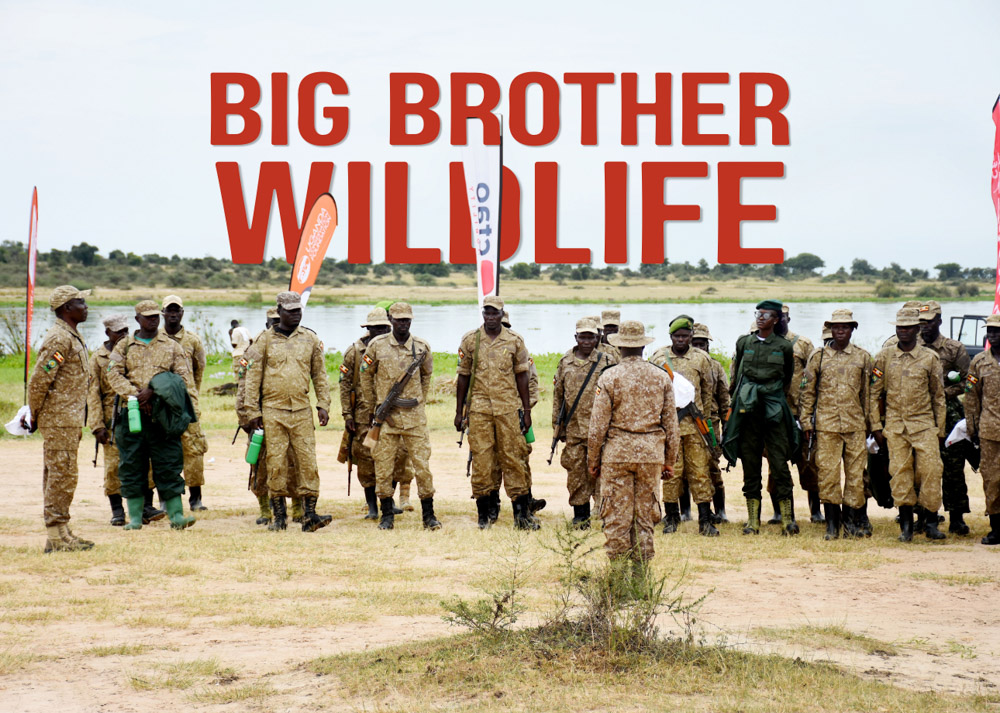
Surveillance technology designed to protect endangered species is being weaponised against communities living in natural areas across the African continent. Its repercussions range from harassment to physical violence.
Modern wildlife conservation has, in effect, morphed into a video game with real-world consequences. AI-powered surveillance systems, military-style drones, individual animal tracking, Special Forces veterans, and satellite imagery are now routinely deployed to protect endangered species. As the Sixth Extinction looms and poaching syndicates continue to gain ground, the sector increasingly relies on counter-insurgency tactics and paramilitary-style units. Organisations such as the Dutch-originating non-governmental organisation African Parks now manage a substantial force of around 2,000 rangers across the African continent.
However, while the elephants may benefit, people living in these areas often experience the situation very differently. Human rights abuses are widespread, community privacy is sacrificed in favour of mass surveillance, and local populations are subject to violent enforcement. The protection of wildlife has transformed hunting and fishing communities into so-called “poachers” and, by extension, criminals, while the underlying drivers of poaching — poverty, land dispossession, and the lack of viable livelihood alternatives — remain unaddressed. Even those who simply seek to defend their land risk arrest, abuse, and imprisonment.
A sound from the sky
In the village of Huntingdon, near Kruger National Park in South Africa, raids often began with a sound in the sky. In research by geographer Mbuelo Laura Mashau, published in 2022 but drawing on events dating back a decade, residents described the terror of surveillance helicopters flying so low over their homes that they would wake sleeping children and shake rooftops — a signal that the village was “under the spotlight” and that a raid was imminent. One resident recounted that when security forces arrived, they would “kick your door down”, terrorise the household, and tie some suspects’ “private parts with an elastic band” during torture sessions intended to extract information about poaching.
Community members reported systematic beatings
All respondents reported being aware that suspected poachers were killed within park boundaries, often without any attempt at arrest or trial. “Whether you are poaching or not, as long as you are found inside the park, you will be killed,” one resident said. (In a 2014 investigation, ZAM also reported on this: ZAM Magazine investigation – Hunting Season.)
Sleek cameras
The situation has reportedly improved since then, with Kruger National Park and conservation NGOs in South Africa adjusting their rhetoric to reflect greater concern for surrounding communities. However, “I wouldn’t say that the infrastructure is dismantled,” says Annette Hübschle, a University of Cape Town researcher who has studied the militarisation around Kruger for many years. She cautions that the recent withdrawal of international donor support for conservation is driving a regression: “Fantastic programming involving communities, social welfare and educational initiatives has been defunded. So there has been a (new) focus on hard power [now].”
Research by University of North Carolina sustainability researcher Taylor Marie Oulette confirms that “despite the scale of the wildlife economy in the region, local communities (around Kruger Park) remain largely excluded from meaningful, long-term economic opportunities. Current conservation models limit opportunities to low-wage roles in anti-poaching units, maintenance, and tourism services,” she writes.
The high-tech surveillance infrastructure makes even human and land rights activists feel unsafe. Passing a college near Kruger National Park in South Africa, Anika* observes “tall poles, sleek cameras, boxes on fences… every vehicle scanned; my [truck] logged twice.” She adds, “Now I feel a low-grade anxiety… if I drive to a community meeting about land rights, will my plate be flagged? That’s the chilling effect; you start to self-censor your movements.”
In response to detailed questions, a spokesperson for Kruger National Park stated that “SANParks is not aware of these allegations.” South African National Parks, the country’s conservation authority responsible for managing Kruger and 19 other national parks, declined to comment, as did the South African Police Service.
Uganda’s army
Uganda’s autocratic regime, long notorious for cracking down on political dissent, has also deployed wildlife park rangers as instruments of state violence. This has led to numerous allegations of human rights abuses from communities living adjacent to wildlife parks in Uganda (see below). Since May 2017, more than 2,500 court cases against individuals accused of poaching have resulted in at least 600 convictions.
The tools were bankrolled by Western donors
Among the evidence presented to the wildlife courts in these cases are Global Positioning System (GPS) coordinates from an open-source surveillance platform called EarthRanger, which can demonstrate that suspects were at a specified scene on the date and time indicated in the charge sheet. EarthRanger is a real-time conservation management platform that aggregates data from GPS collars, radios, patrol logs, vehicles, aircraft, and sensors, displaying wildlife, rangers, and incidents on a live operational map while generating alerts and maintaining detailed historical records for managers.
Another tool used by rangers and prosecutors is EcoScope, an analytics add-on within the EarthRanger ecosystem. It draws patrol, subject, and event data from conservation systems and automatically converts them into dashboards, maps, and charts. It can centralise large volumes of information, including patrol routes, wildlife concentrations, and clusters of specific incident types, which would otherwise require bespoke statistical work. When integrated with phone, vehicle, or camera data, which are also often monitored by park officials, such a system can be used to profile areas and groups and identify “hot spots” for intensified policing. The UWA and its UPDF auxiliaries also use drones and other AI systems.
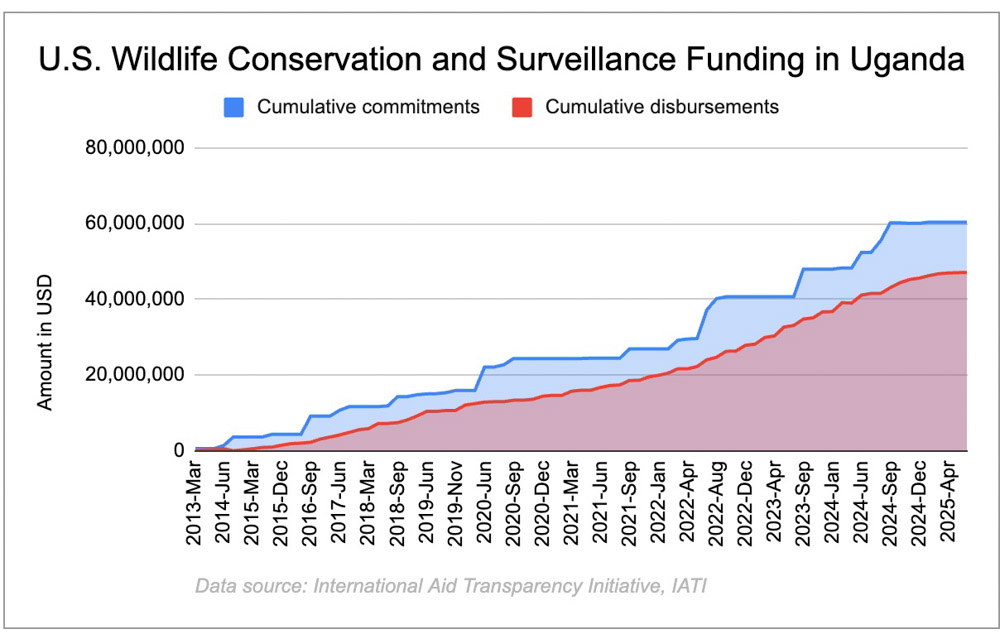
Until recently, these technologies were financed by Western public and private sector donors. US funding for wildlife conservation surveillance, now halted following the Trump administration’s cuts to USAID, included more than US$100 million provided to the Ugandan government between January 2020 and June 2025. The US Department of State, now acting as a surrogate for USAID, declined to comment on these figures.
Wrong elements
In response to questions, UWA spokesperson Bashir Hangi confirmed that substantial funding for Uganda’s conservation efforts has also come from other foreign backers, including France, the United Kingdom, the Netherlands, and Italy. He stated that the money has “largely been used for enhancing conservation capacity and not militarisation of conservation,” although “portions of the money are going into purchasing surveillance equipment and building weapons storage facilities.”
“Someone who wants ivory comes with guns”
“The issue here is not militarising conservation, as you put it,” Hangi says. “It is more about enhancing our capacity. The threats to wildlife are real. Someone who wants ivory comes with guns, so the question is: how prepared are we to counter them?”
Hangi denies that the Uganda Wildlife Authority (UWA) or the army, the Ugandan People’s Defence Force (UPDF), enter communities. “We restrict ourselves to the park boundaries, so communities shouldn’t be worried. Spying on them is not our work. Our job is to protect the wildlife inside these protected areas against incursions by wrong elements.”
Annet Tuheisomwe, head of the prosecution unit at the UWA, says that even when surveillance devices capture information outside the park, it is handled confidentially. “The only people who should be worried are those who are committing crimes.”
Encroaching
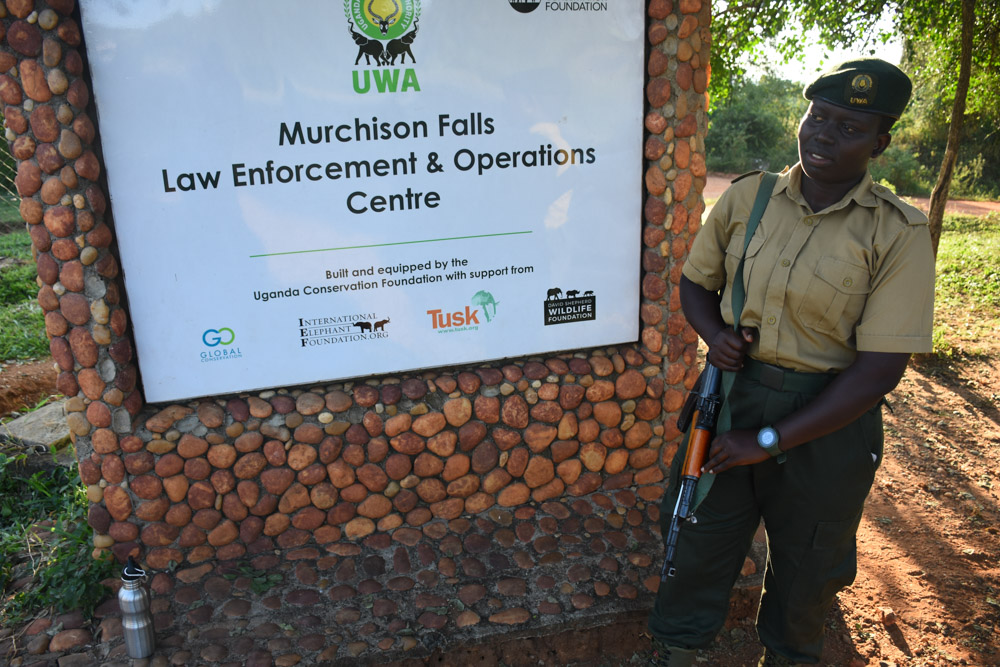
Residents of Luwora village in Nwoya District, which borders Murchison Falls National Park, tell a different story. Luwora resident Charles Oyaka (20) was arrested on 19 December 2025 while grazing cattle. He claims he was herding the animals on his family land when three park rangers arrested him, alleging that he had “encroached” on the park. “At first, they took me to their post near the River Ayago, where I was badly beaten. After that, I was taken to another post in Wangkwa, and later to Paraa, where I spent the night. There, I found five other people who had also been arrested. The room we slept in was small and stuffy, making it difficult to sleep. We had to take turns sleeping because it was too small for all of us to fit comfortably. Before travelling to Masindi [Central Police Station], we were beaten again.”
“I pray that rangers are exposed for their brutality against our children”
Oyaka’s father, Martin Okello (63), told us that although the local court in Masindi released his son for lack of evidence, a court clerk allegedly withheld the release documents until he was forced to pay a bribe of 500,000 Uganda Shillings (about US$135). “My prayer is for the rangers to be exposed for their brutality against our children. Right now, my family lives in fear and cannot work in the garden because they are afraid of being mistaken for entering the park.”
Barricades
Ben Okello (not related to Martin), a local councillor in Purongo Sub-County, says arrests have recently increased and that the main complaints from local residents are the alleged brutality of the rangers and the decision to try all poaching cases in a single court, which limits relatives’ ability to follow proceedings involving their loved ones.
The wildlife courts also generate discontent because, due to state corruption, high-level wildlife trafficking kingpins, who move ivory and pangolin scales by the ton, routinely escape custodial sentences through plea bargains and fines. “You can pay 50 million Ugandan shillings [roughly US$13,000] and walk free, your criminal network intact and operational,” says Moses Olinga, a Uganda program manager at the International Fund for Animal Welfare. “While villagers caught with a piece of bushmeat can, in theory, receive several years in prison.”
Similar complaints were documented in Al Jazeera’s 2025 investigative documentary, Death in the Park, which examined allegations that rangers shot and killed dozens of local residents in Murchison Falls National Park and subsequently concealed the evidence.
Villagers go to prison, kingpins walk free
Councillor Ben Okello says he has attempted to mediate between the community and the Uganda Wildlife Authority (UWA). “Recently, we held a community dialogue where we invited officials from UWA, the police, the army, and local leaders. We wanted to understand what is happening with UWA and why there are so many reports of rangers mistreating locals. Many residents are now threatening to erect barricades on all community access roads and to stop selling food and other items to anyone working for UWA,” he said. The discussions have so far not led to any change in the situation.
Us and them
Although Hangi insists that the UWA does not “spy on communities,” conservation and environmental security expert Rosaleen Duffy of the University of Sheffield argues that state actors are often “interested in everything that it’s recording, like literally everything,” and that such a “digital dragnet (…) hoovers up enormous amounts of information.” This data can then be used by state security forces to monitor civilians, track community movements, and suppress dissent under the guise of biodiversity protection. “The mindset is of us and them,” she notes. “Local communities are defined either as the enemy or as potential collaborators. But unless you address the structural reasons why people engage in crime (like poaching), you’re never going to get a solution.”
Conservation scientist Taddeo Rusoke of Uganda’s Nkumba University, who has conducted research in wildlife areas, confirms that the militarisation of conservation in the country’s parks has eroded much of the trust previously built through community engagement. He notes that the coercive approach “turns conservation areas into conflict zones.”
Rebel groups
UWA spokesman Bashir Hangi acknowledges that the approach is also rooted in genuine security concerns. He explains that, because a significant number of Uganda’s national parks are located along international borders, the presence of the UPDF “helps to prevent armed rebel groups such as the Lord’s Resistance Army (LRA) in the past and the Allied Democratic Forces (ADF), who have military bases in DR Congo, from using the parks to prepare to fight the army or civilians. (…) We’ve had some cases along the South Sudan border [near Kidepo Valley National Park] where some armed people have tried to cross and come to Uganda. We didn’t allow them to cross over into the country and cause the mayhem, but that’s probably what they would have wanted to do. And this is why we work closely with the UPDF.”
Asked whether he feared that otherwise peaceful communities such as those in Luwora might turn against the UWA and the government and become susceptible to militant propaganda precisely because of the militarised approach, Hangi said that the UWA “has programs designed to win over locals,” including “UWA’s revenue-sharing policy to invest 20 per cent of park entry fees in communities; conservation education for local communities; and human rights-based training for park personnel.” He emphasised that “for us to succeed, we need the support of the public. We are their servants.”
Uganda’s appetite for surveillance tech is still rising
Uganda’s appetite for surveillance technology continues to grow. Budget requests for the 2026/2027 financial year include US$3 million for a helicopter to “ease aerial patrols, wildlife surveillance, animal census exercises, and rescue operations, particularly for animals caught in poachers’ snares.” A further US$8.4 million will go towards constructing electric fences in Murchison Falls and Queen Elizabeth National Parks. By contrast, only US$3 million is allocated for compensating victims of human–wildlife conflict.
Going private
As US funding has declined to a mere trickle, the privatised anti-poaching industry has expanded to fill the gap. Ex-military contractors from Iraq and Afghanistan have entered African conservation zones through organisations such as VETPAW, a unit of US military veterans “empowered to protect wildlife” that operates primarily in South Africa, and Akashinga, a task force of women trained by Australian Special Forces veteran Damien Mander.
Akashinga, which conducts anti-poaching operations in Zimbabwe, Mozambique, Botswana, and Namibia, said in response to questions that it does not use counter-insurgency tactics; that it has “evolved away from a war on poaching”; and that its operations are “intelligence-led, community-grounded, and demilitarised.” VETPAW did not respond to repeated attempts to obtain comment.
The most recent iteration of the private, militarised approach to conservation, however, is not a veteran-run outfit but the Dutch-founded African Parks, a large NGO that claims to manage 24 protected areas across 13 countries, covering over 20 million hectares on the African continent. African Parks is presented to its donors as purely “green,” with brochures featuring majestic animals against sunsets over pristine savannahs, and annual reports filled with buzzwords such as community partnerships, local empowerment, and sustainable livelihoods.
But it has arguably built a private army. With a 2,000-strong ranger force patrolling millions of hectares across the continent, this non-state actor wields more on-the-ground power than many sub-Saharan African governments’ environmental agencies.
African Parks is a “state within the state”
“The situation is different from one country to another,” said investigative journalist Olivier van Beemen, whose award-winning 2025 book Entrepreneurs in the wild (1) examines the organisation in depth. “But African Parks’ model of delegated management — in which it assumes full authority from governments over parts of their territory — is often perceived as a ‘state within the state.’ African Parks takes over responsibilities such as law enforcement, the monopoly on the use of force, and the right to detain people from national authorities within a protected area, and often in a surrounding zone as well.”
Good faith
A spokesperson for African Parks responded to questions by stating that “core to all protected areas is legislation determined by sovereign governments, so we do not operate as an unaccountable private military entity”; that the NGO’s “accountability mechanisms have been constructed in good faith and in accordance with international standards”; and that its grievance mechanism “integrates independent, external oversight bodies at all stages, from detection to resolution of complaints.”
Rosaleen Duffy, however, argues that a fundamentally different model of conservation is needed: one “with binding human rights safeguards, actual enforcement mechanisms (for these rights), and consequences for violations. It would probably also mean mandatory independent oversight of all security actors, whether state rangers, private contractors, or NGO-funded paramilitaries — who now operate without any common code or set of guidelines — as well as transparent complaint mechanisms accessible to affected communities.”
*Anika is a pseudonym, allocated to protect her Identity.
(1) "Entrepreneurs in the wild" has been published in Dutch, German, French and Italian; a UK version is being awaited.
This story is the result of a collaborative investigation by Benon Herbert Oluka in Uganda, Sam Schramski in the United States, and Tulani Ngwenya of Oxpeckers Investigative Environmental Journalism in South Africa. Data research was provided by Purity Mukami. The project was supported by the Pulitzer Centre.
Call to Action
ZAM works towards a new equal relationship between Africa and Europe. Contribute to our mission by donating.