How class action lawsuits did not bring lasting change to exploited communities in Mozambique and Malawi
Very little has changed in Montepuez since the lawsuit. The Gemfields mining company, with its London head office and its local ruling party co-owners, still guards its concession avidly. Poverty reigns behind the “forbidden to enter” gates. Villagers trying to dig for gemstones on the land of their birth still risk being shot by special forces. Other means of earning a living remain scarce after, a decade ago, locals were uprooted from farms and shops to make space for the concession and then for more concessions.
Rubies and tea
In 2019, 273 inhabitants of Montepuez received substantial damages pay-outs from a class action lawsuit brought on their behalf by the London, UK law firm Leigh Day against the gemstone multinational Gemfields, also headquartered in the UK, which mines rubies in the Montepuez region. Leigh Day and others heralded the court victory as a major triumph of right over wrong. But the money, not enough, several villagers claim, came and went, and exploitation and violence continued.
A similar lawsuit also failed to bring "lasting, systemic change", -as Leigh Day partner Daniel Leader says his firm hopes for-, in Malawi. There, in 2021, a class action against UK-based tea companies over the sexual abuse of tea pickers by supervisors on plantations also won in the UK. However, “despite legal settlements and promises of reform by plantation owners, women continue to face harassment, coercion, and violence at the hands of their supervisors. The systemic abuse, long hidden behind the veil of Malawi’s booming tea industry, remains a painful reality for hundreds of women,” our colleagues at the Platform for Investigative Journalism (PIJ) in that country report.
Beneficiaries in both countries report continued abuses
A shouting minister
There are other similarities. Beneficiaries of damages pay-outs in both countries report either neglect or even further victimisation by local authorities, as well as by criminals and conmen who came to “help” the often illiterate recipients with their bank papers. In Malawi, women who had received money were rumoured to be witches and Satanists, a situation exacerbated by the fact that they had signed non-disclosure agreements forbidding them from speaking about the rapes. Neither the police nor the labour department ever took an interest in their complaints, either before or after the law firm’s intervention.
The minister who had been in charge of the labour department when the abuses cited in the Leigh Day lawsuit were committed, Vera Kamtukule, shouted at the journalist who questioned her about the matter: “You betray Malawians! This kind of news endangers our industry of 60,000 workers!”.
In Mozambique, police, politicians and members of the secret service accused beneficiaries of being “terrorists”, claiming that their pay-outs had come from insurgents known as “Mozambican Al Shabab”. A 2024 uprising against the corrupt government saw recently acquired housing, small farms and vehicles, purchased by claimants with their damages payments, go up in flames.
In Mozambique, beneficiaries were accused of being terrorists
In both countries, there were unwise purchases too, made by people who had never handled more money than was needed to buy bread or a few vegetables, and who entered a sudden state of euphoria well known to lottery companies as a risk (see box). But that is the argument used by the corporates, says Daniel Leader: that we “must not give poor people money because that will upset the community.” Surely we do not want to side with the multinationals on that?
Financial management
Why was financial management training not provided to Montepuez beneficiaries, when it is offered even to lottery winners in Western countries such as the UK? “We thought they should have that training, and we had a local NGO in place to facilitate it, but the beneficiaries all refused when they were told it would cost them a small portion of their damages payments,” says Leigh Day’s Daniel Leader. “Though we tried to convince them.”
Leader admits that it was perhaps to be expected that people would feel unwilling to accept such a deduction. “But we could not help that. There was no pot of money made available by the multinational Gemfields for this, so it had to come from the payments.” It was a learning experience, he reflects. “We now make sure that money for this purpose forms part of any new settlement we negotiate.”
But by far the worst aspect, both groups of beneficiaries in Mozambique and Malawi say, is that the perpetrators of abuses against them not only remain unpunished but still hold their posts in management and, in some cases, official positions in government and law enforcement. In Mozambique, the multinational Gemfields continues to partner with the local MRM mine, owned by General Raimundo Pachinuapa, who is closely associated with the country’s ruling party, Frelimo.
The same managers, supervisors and police officers still hold power
It was the Frelimo government that paved the way for the MRM/Gemfields partnership in the first place by forcibly removing Montepuez villagers in 2015 from the land they believed was theirs. Further government concessions to others, also involving ruling party shareholding, followed. Locals in the region were, and remain, dispossessed of farms, small businesses and former artisanal mining livelihoods. This is why young men, and some women, still risk their lives venturing into the Gemfields concession to mine rubies illegally. A list of new victims of Mozambican law enforcers, who continue to extort, assault and shoot such locals, was recently published by ZAM.
If anyone could act to address the abuses and restore some land ownership, including artisanal mining plots, to his countrymen and women in the province, it is General Pachinuapa. But he does not. Locals see MRM and Gemfields executives and managers, whom they believe to be complicit in killings on the land, speed past in their shiny 4x4s. In Malawi, local management continues to retain rapists as supervisors. “The perpetrators remain managers, captains, and clerks, who exploit their authority,” our colleagues write.
Bread and butter
“We know this,” says Leigh Day’s Daniel Leader in our interview. “And we also grapple with these important questions. But as long as justice systems in such countries remain corrupt, we see no other way to secure restoration than to hold the corporates to account in their own jurisdiction and hit them where it hurts.”
Class action lawsuits are Leigh Day’s bread and butter. The firm presents itself proudly as human rights lawyers, seeking out communities, often in Africa, whose environment and livelihoods have been damaged by UK-based multinationals. The London-based lawyers then initiate court proceedings in the UK on behalf of these communities, demanding substantial damages from the corporations concerned. Their cases resound with descriptions of suffering, supported by testimony from doctors, trauma experts and psychiatrists. After deducting their costs and fees they distribute the damage payments to the community members on their list. Some of their logos and signage underscore the message in large letters: “Lawyers Against Injustice.”
Screenshot home page Leigh Day
“You were paid, and there is no more.”
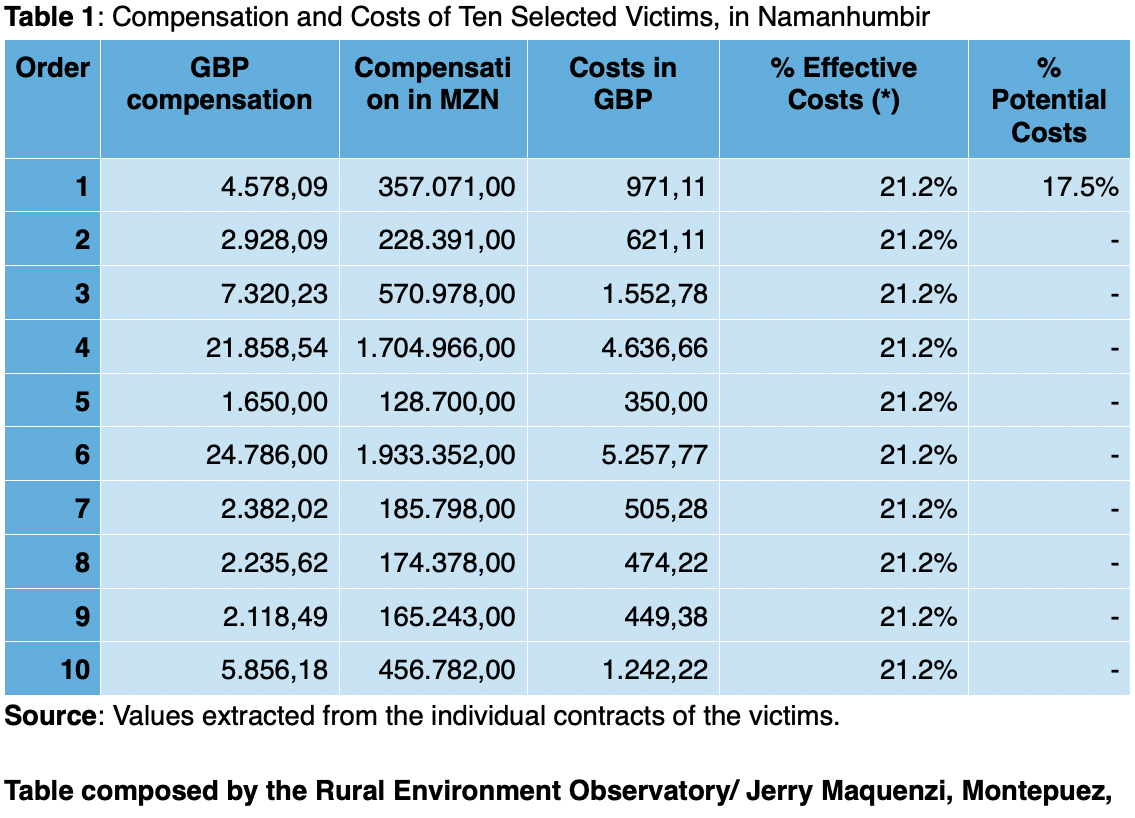
But a group of locals in Montepuez, six years on, say they are back at square one, even though the lawyers secured substantial payments, ranging from GBP 5,000 to GBP 20,000, for the 273 victims of forced removal, violence and dispossession. The group of around 20 former beneficiaries has complained to Estacio Valoi, saying they did not receive all that had been promised, that deductions were made of which they had not been informed, and that they are still awaiting final tranches of payment. Much of the anger centres on what they see as a 21.2 per cent deduction for Leigh Day’s fees from their pay-outs, whereas they say they had been promised that the deduction would be limited to 17.5 per cent.
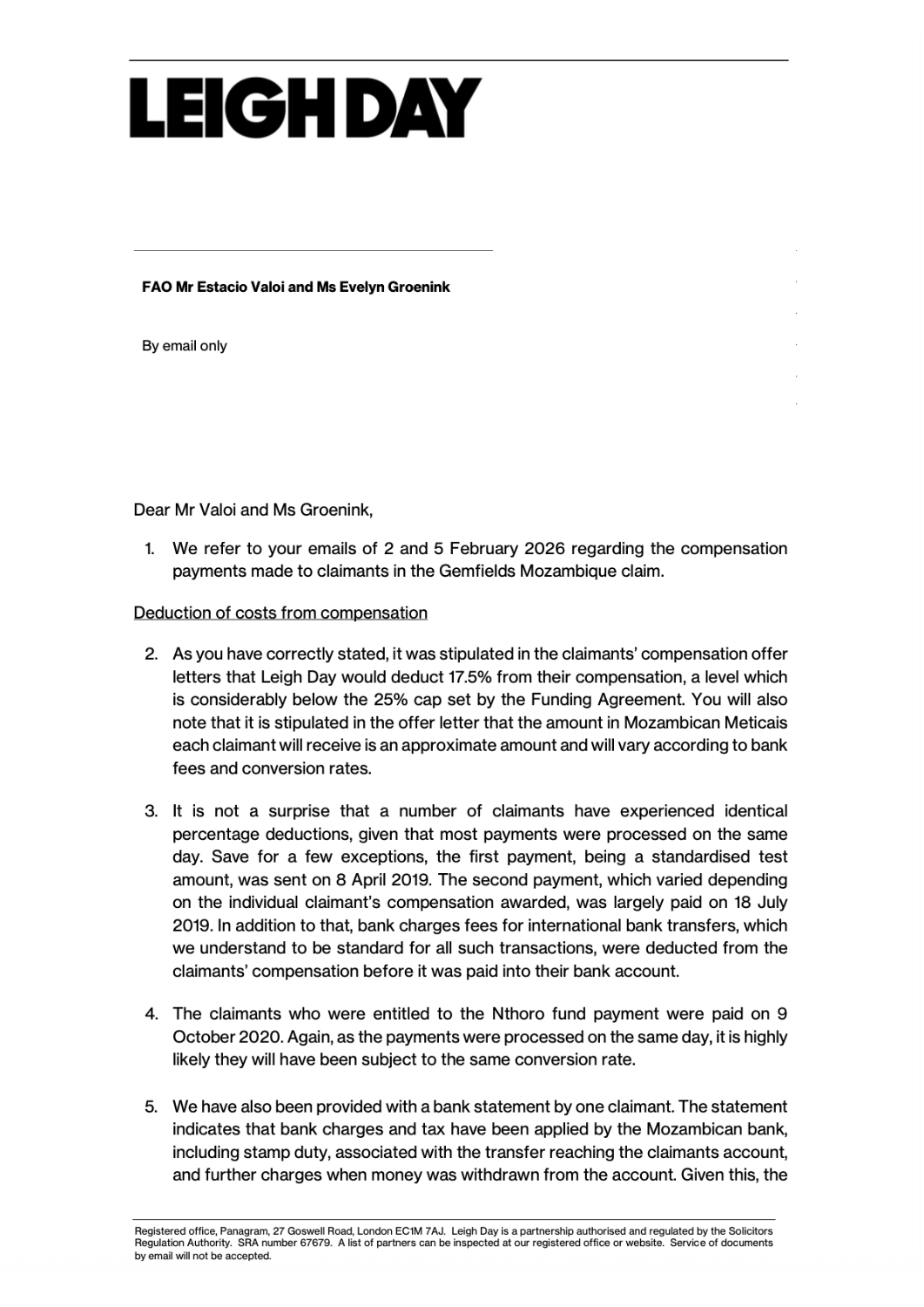
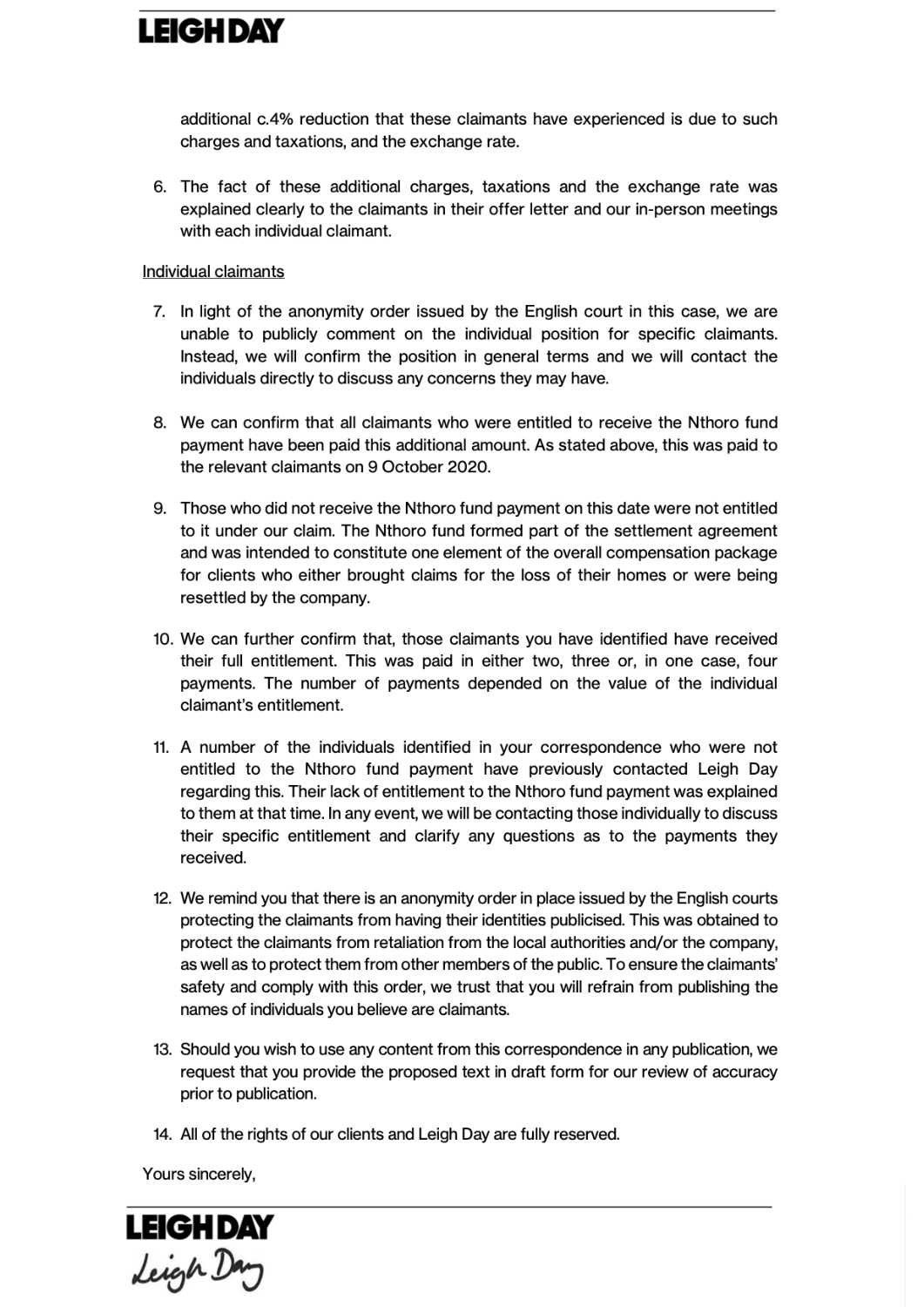
Leigh Day strenuously denies taking more than 17.5 per cent. The firm stresses its goodwill in the matter, explaining, with an undertone of evident hurt, that legally it would have been entitled to as much as 25 per cent. “There are firms that would take 40 or even 50 per cent,” says Daniel Leader. Calculating the GBP deduction from the gross amount before it left London, as stipulated in the contracts, ZAM finds the firm is correct: it is 17.5 per cent, as per the agreements.
The group's complaint may be related to the fact that the contracts stated an amount in local metical currency, the value of which may have declined by the time payment was made. “The amount written in metical is an estimate and will depend on bank charges and the exchange rate (…) I know that we also explained that in person to each of the individuals,” one of the lawyers, Matthew Renshaw, writes in an email following the interview with Leader.
Feelings of loss and betrayal
“Still, to us here, it is 21.2 per cent,” says Estacio Valoi. "They should still come here and explain. I cannot explain it when they ask me.” 3.7 per cent makes a lot of difference if you live in Namanhumbir. Especially if your contract, with the foreign words in it and its different currencies, pounds and US dollars alongside meticals, is all you have, and if your math-savvy acquaintance in town counts the metical difference out for you and keeps coming to 21.2 per cent.
The locals call the lawyers their ‘bosses’
They have never seen the lawyers’ glass-walled offices in London from which they came. Our “bosses”, they call them, for what else do you call people who hand you contracts stating the amounts they promise to pay? They have kept those contracts safe, though it is hard to imagine how, through rainstorms and the smoke of charcoal cooking. One contract was even rescued from a fire, the burn holes still visible.
Estacio Valoi has consistently documented the locals' lives under siege by the mining operation and is now seen by many as the one accessible point of contact that remains. “They phone me night and day,” Valoi says. He continues to listen and to document their misery, as he has done from the beginning, when he wrote the stories that prompted Leigh Day to approach the community in the first place, and when he travelled with the lawyers, organising translation and contacts. “That was risky, because the police and the secret service, SISE, were tracking us. We knew we would still be living in the province after the Leigh Day people went back to London. But we took that risk because we knew it was about human rights and social justice.”
One contract has been rescued from fire
Now, while the lawyers have long since returned to their offices and their next cases (“we can’t respond within a week because the person who dealt with this is now in Nigeria”), it is once again Estacio who channels the group of Montepuez villagers’ continuing despair to them. “They were hoping for justice and human rights, but what they got was some business, and then it stopped,” he says. “It’s good that the people received some money, but there has to be another way. Why are the murderers still in power in Montepuez? Why have they not been held accountable for their crimes?”
Different universes
This story, then, is one of different universes, worlds that touched once and then immediately separated again, leaving local injustice unresolved. Daniel Leader admits that this is a real problem, one faced even by the lawyers themselves. “Even at the time in Mozambique, our work in the area was blocked at every turn.” A letter sent by Leigh Day to Mozambique’s attorney general, after the lawyers’ delegation returned to London following a final visit in 2019, describes a meeting with state officials in Montepuez, “where also were present the director of Criminal Investigations and a gentleman who, as far as we understand, works for SISE.” Accused of numerous political killings in Mozambique, the feared SISE was by then already known to be seeking out villagers rumoured to have come into money, and then threatening and extorting them.
The secret service demanded all the papers
At the meeting, according to the letter, local state and law enforcement representatives told the lawyers that “they could only continue the work if they would hand over all the UK court case documents, including the list of identities of the claimants.” “They wanted these names to collect their share. It was as if they wanted their own compensation because the lawsuit was interfering with the ruling Frelimo party generals’ mining business,” says Valoi. Valoi believes “the lawyers should not have gone to that meeting. On our side, we always try to dodge these people.”
The letter further shows that Leigh Day sought to reason with the local dignitaries, explaining the confidentiality clauses and pointing out that they had been granted permission to operate in the country by the attorney general herself. It was to no avail, and even a subsequent meeting in the capital, Maputo, did not help: they were instructed to leave Mozambique forthwith. “Still, we found a way around it to ensure the claimants were paid,” says Daniel Leader. “And we kept local staff in place to see to it that all payments were completed.”
But is there then no way to hold abusers to account locally? Daniel Leader thinks not, “as long as local justice systems remain corrupted.” He favours continuing to address the multinational enablers of exploitative local elites, “and starting a new case if necessary. Because we also do see real lasting wins.” He cites several examples, most prominently “a case against a company that runs a big farm in Kenya, which in the past stopped community people from crossing the area for their daily needs. The company agreed to construct three roads. And they have female security guards with bodycams to guarantee the safety of the locals who pass there.”
Grievance models
Leigh Day also typically demands the establishment of Operational Grievance Mechanisms (OGMs) within the companies with which it reaches settlements. These OGMs function as virtual post boxes through which victims of a company’s operations can continue to report abuses. “And these are monitored by independent experts.” But do villagers in Montepuez still record their experiences there? And if they do, do they receive answers? “There was a box where people could post complaints, but they stopped, I think,” is what Valoi knows, adding that “the reality is that people just phone me and the journalists’ crew that works with me. Just us. They have been phoning us for years.”
It was all that phoning that ultimately led Valoi to reach out to ZAM and to our partnership working on this story.
Asked whether Leigh Day might consider other measures, such as establishing a legal fund from which local lawyers could pursue follow-up actions or bring cases against local authorities, Daniel Leader questions whether these “will be successful in justice systems like in Mozambique.” “If you work with local lawyers, in a local-foreign partnership, taking both sides on and going to court in both places, you can be successful,” insists Valoi. “We work with local lawyers all the time.”
“The feeling here is disappointment.”
We leave the interview thinking that perhaps a new model for class action lawsuits could be developed, possibly even with the help of Leigh Day. At least, that is what our white half, Evelyn Groenink, thinks. But the Mozambican half doubts. “The feeling here is just disappointment", Valoi grunts, years of frustration furrowing his face.
Response Leigh Day to ZAM's submission containing Montepuez beneficiaries' complaints
Though the Montepuez complainants' group came forward saying they wanted to be heard, interviewed and photographed, ZAM was advised by Leigh Day that there is a court anonymity order in place protecting the identities of all beneficiaries of the lawsuit. Following the court order, ZAM has made the individuals in the above picture unrecognisable.
See more on the Montepuez ruby mining and the Malawi tea plantations:
Samantha Kureya was abducted and tortured, yet came back to continue her comedy show. Satirical performer Bon Kalindo was arrested fifteen times. Cartoonist Mustapha Bulama was slammed by Nigeria's...
Two comedians, also anti-corruption activists, have served in Malawi's government. One quit first, then the vice president who brought him in died in a much-investigated plane crash, and the other,...
A Malawi flag on a stage where young women are dancing to celebrate their welcome into Alabuga is the only physical sign of participants from my country in all the material emanating from this indu...
Among the shocking findings of this transnational investigation, is the involvement of high-ranking government officials in six of the seven countries—in sending their countries’ young women ab...