
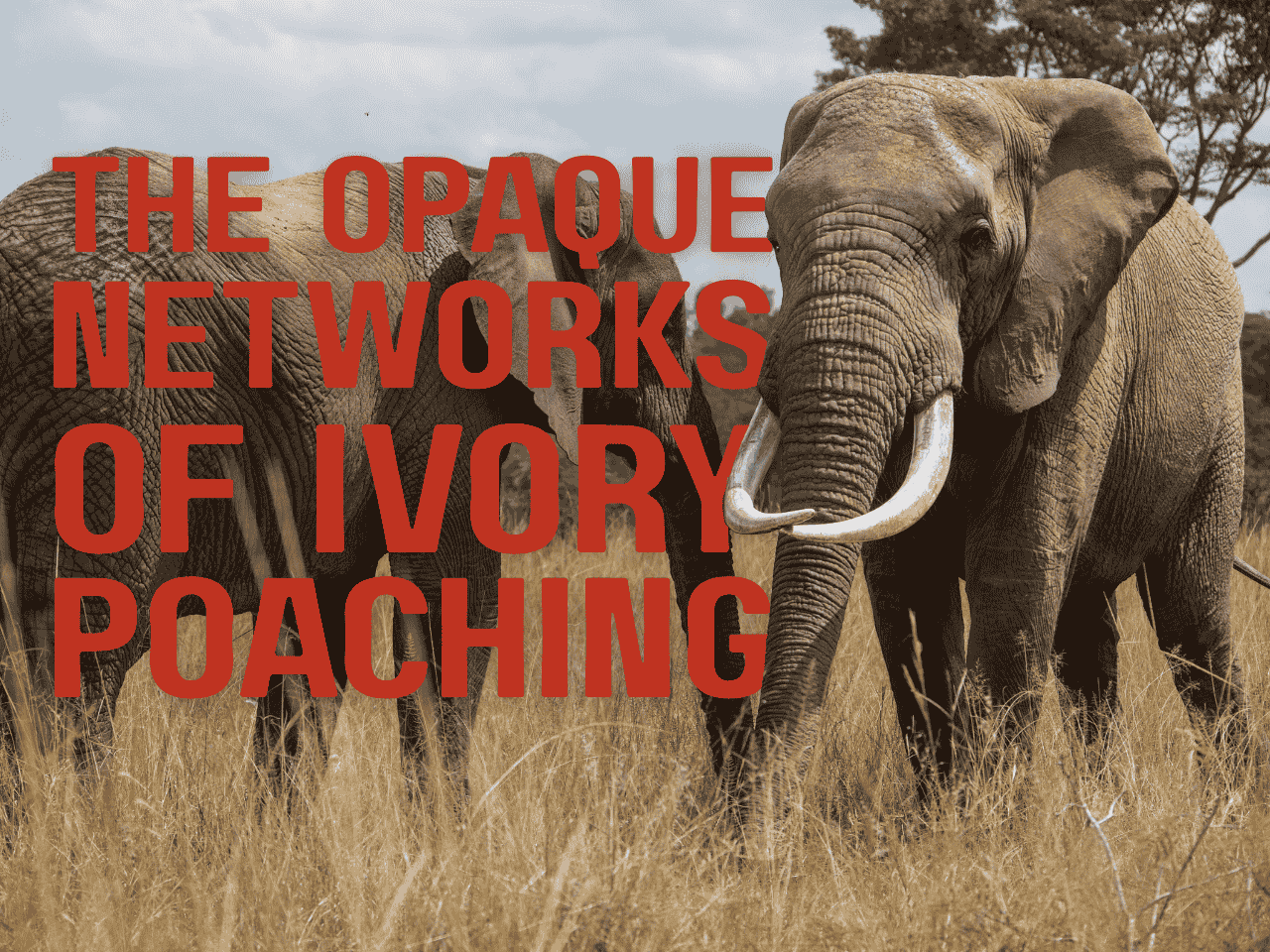
Ivory trafficking in the West African country of Benin is endangering the elephant population, causing losses to the tourism sector, linked to terrorist activities, and driving the outflow of millions of dollars that fuel international organised crime. Yet these trafficking networks continue to evade justice, a new investigation by Matin Libre shows.
Elephant poaching for their ivory tusks is a scourge of Benin's national parks, located in the north of the country. According to data collected by Matin Libre, at least 169 elephants were killed for their ivory there between 2002 and 2024, amounting to 338 ivory tusks sold on the illegal market for a total value of several million US$. According to the International Union for Conservation of Nature (IUCN), the ivory trade represents approximately 23 billion US$ annually worldwide.
A range of techniques
Ivory poaching invariably involves killing the elephant, after which "the ivory is sheared and cut with a chainsaw. Poachers have developed a whole range of techniques to transport it to other countries," Georges Sossou, technical director of CENAGREF (the National Centre for Wildlife Reserve Management) in Benin, told Matin Libre.
“They cross the border with weapons”
A religious leader in a village bordering Pendjari National Park — a community from which many poachers originate — claims that syndicate members, whom he calls “transporters,” arrive in Benin from Nigeria “armed with poaching weapons.” They then recruit local poachers, whom they pay, “sometimes in advance, to motivate them.” He adds that he believes the ivory is mostly taken back to Nigeria. But how do the tusks cross the border? “Well, they (the transporters) also manage to smuggle bullets. They make sure everyone gets their share,” he shrugs. According to the same religious leader, poachers have told him that they sometimes operate with the complicity of certain forest rangers, who provide them with information on patrol routes and, above all, the ideal time slots for their attacks.
African Parks
The General Directorate of Customs did not respond to our request for comment on the matter, nor did the General Directorate of the Police. With regard to the alleged complicity of certain forest rangers, the Director General of CENAGREF, Colonel Abdel-Aziz Baba Moussa, referred the question to the international conservation NGO African Parks, which has managed Pendjari since 2017 under a long-term agreement with the Beninese government. “I cannot comment on actions that have been under the jurisdiction of African Parks for more than five years,” he said. Jacques Kougbadi, head of communications for African Parks in Benin, in turn referred our questions back to CENAGREF.
All the sources consulted by Le Matin Libre for this investigation agree that the poachers are merely a small cog in a vast machine. Lieutenant-Colonel Amandine Assogba Déléké Gnido of the state Water and Forestry Service told us that “ordinary poachers come from impoverished regions and are the lowest paid, sometimes scarcely enough to survive, while taking the greatest risks, including conflicts with law enforcement, arrests, and injuries. The main beneficiaries are international networks and intermediaries — traffickers, transporters, and bogus exporters. They purchase at ridiculously low prices, obtain logistical support such as falsified CITES (Convention on International Trade in Endangered Species of Wild Fauna and Flora) documents, and then resell the animals at exorbitant prices on international markets.”
“Main beneficiaries are dignitaries and officials”
Joséa Dossou-Bodjrenou, director of the Beninese environmental NGO Nature Tropicale, which partners with the country’s AALF (Assisting the Application of Laws on Flora and Fauna) project by working with police, park guards, and the judiciary to enforce wildlife laws, says that local village-based poachers receive only between 80,000 and 150,000 CFA francs (123 to 230 euros) per kilo, while on international markets a kilo of raw ivory is worth “more than EUR 1,000.” From his experience, he suspects that “the main beneficiaries of this trafficking are dignitaries, local elected officials, and politicians whose activities are financed by these same traffickers.” He admits, however, that not one such suspect has yet appeared in a Benin court, explaining that “even poachers from the poorest villages appear in court with private, expensive lawyers, or somehow find ways to appeal their convictions.”
Indirect pressure
Jeffrey Rosland Gouhizoun, a lawyer at the Benin bar, confirms that he has observed indirect pressure on these cases, manifested through delays, dismissals, and witnesses refusing to appear after intimidation. “Indeed, these cases rarely, if ever, result in convictions against the poachers’ recruiters,” he says. This, Gouhizoun adds, is despite judicial investigations that have uncovered “organised and compartmentalised networks of poachers, collectors, transporters, and exporters, including the use of forged logging permits, veterinary certificates, fake licence plates, and evidence of transit through several countries, including Togo, Nigeria, and Cameroon.” “Yet,” he says, “no high-ranking political figures in Benin have been publicly convicted of trafficking (elephant tusks).”
Ulysse Korogoné, head of the National Control and Litigation Service at the Directorate General of Water, Forests, and Hunting, and CITES focal point, confirms in an interview with Matin Libre that current investigations are beginning to trace the trafficking back to “the big boss, comfortably ensconced in his office, with millions, even billions, ready to exploit the available mechanisms to launder this money.” Yet he, too, is unable to cite any recent convictions of individuals other than low-level poachers.
The last known cases against officials were in 2014 and 2017
The last known cases of ivory trafficking involving state officials date back to 2014, when, according to a report by the NGO Conservation Justice, Valentin Tankouanou, a forest ranger with CENAGREF, was sentenced to three years in prison for “complicity in poaching in Pendjari National Park.” In 2017, according to lawyer Jeffrey Gouhizoun, forest rangers implicated in poaching in W National Park, further northeast, were also prosecuted. A letter sent by Matin Libre to the clerk of the Cotonou Court of First Instance, requesting an updated list of judgments handed down in poaching and ivory-trafficking cases, has received no response.
Attorney Gouhizoun, who has defended poachers before the regional courts of Djougou (463 km north of Benin’s capital Cotonou) and Natitingou (80 km further north), claims not to condone poaching but remains silent when asked if his fees are paid and by whom. He also refuses to comment on whether lawyers specialising in poaching generally receive exorbitant fees, simply stating that “lawyers’ fees are not regulated.”
Georges Sossou of CENAGREF and Ulysse Korogoné of CITES state that they are unaware of any studies quantifying the losses caused by ivory poaching in Benin. However, data from CENAGREF and CITES, covering the period from 2002 to 2024 (excluding 2022), indicate that 289 elephant carcasses were discovered, 169 of which were found without their ivory. Since each elephant has two tusks, at least 338 tusks were trafficked illegally during this time. Given that an adult elephant tusk typically weighs around ten kilograms, and that the market value of raw ivory ranges from US$750 to US$2,000 per kilogram, these 338 tusks could have generated between US$2.5 million and US$6.7 million for criminal networks.
Terrorist groups
While the losses for Benin’s tourism sector are more difficult to quantify, they are likely considerable, especially given the presence of terrorist groups in West African national parks. These groups operate alongside trafficking networks and are sometimes complicit in poaching. According to the Africa Organised Crime Index 2021, a group called Jama’at Nusrat al-Islam wal-Muslimin (JNIM) had at that time taken control of W National Park and also maintained a significant presence in Pendjari. The index also indicates that the elephant population in W National Park nearly halved between 2015 and 2021. More recent reports, suggest that poaching has continued to increase in recent years in these parks, in tandem with increased militant activity.
A military official, speaking on condition of anonymity, confirmed that the presence of terrorist groups near national parks is “significant.” The permanent secretary of the National Commission for Combating Radicalisation, Violent Extremism, and Terrorism, contacted by email, did not respond to requests for information.
This investigation was conducted with the support of the Norbert Zongo Unit for Investigative Journalism (CENOZO). It was originally published in French. The version above is an edited and translated rendition, republished by ZAM with the permission of the author and Matin Libre.
Call to Action
Working towards a new relationship of equality between Africa and Europe, ZAM platforms African investigation, activism and creativity that challenges exploitation, white supremacy and the erosion of democratic rights. Donate here.